The recently concluded AI Impact Summit 2026 in New Delhi from 18th to 19th February marked a significant milestone in India’s journey toward becoming a global AI powerhouse. With participation from 89 countries and international organisations, and lakhs of attendees including global technology leaders and policymakers, the summit reinforced one clear message — Artificial Intelligence is no longer experimental; it is foundational to economic growth, innovation, and enterprise transformation.
The adoption of the New Delhi Declaration on AI emphasised the “democratic diffusion” of AI — making advanced AI capabilities accessible, safe, and trusted for businesses and communities worldwide. With billions in investment commitments, the launch of India’s first domestically trained large language models, and renewed focus on AI infrastructure and workforce development, the summit has positioned India not just as a consumer of AI innovation — but as a creator and strategic partner in the global AI ecosystem.
In this article, we will cover everything about AI Impact Summit 2026 and what it means to Indian tech, software development & digital innovation.
Objectives of AI Impact Summit 2026
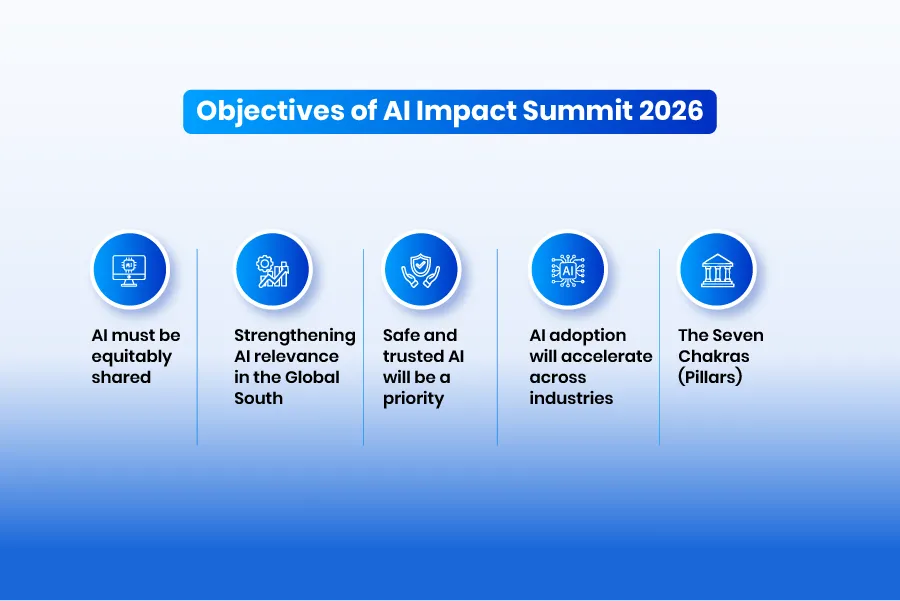
The government of India has set key priorities, which are as follows:
1. AI must be equitably shared
This is guided by the principle of “Sarvajan Hitaya, Sarvajan Sukhaya” (Welfare for all, Happiness for all) that suggests the availability of AI to as many people as possible. This includes equipping women, youth, and emerging entrepreneurs to build equitable solutions via AI-focused programs such as YUVAi (Youth for Unnati and Vikas with AI) and Tinkerpreneur.
2. Strengthening AI relevance in the Global South
The government aims to enhance the representation of underrepresented languages in the training of Western LLMs. This will benefit developing regions and support environmentally sustainable innovations.
3. Safe and trusted AI will be a priority
As adoption increases, organisations must ensure governance, security, and responsible AI implementation.
4. AI adoption will accelerate across industries
With large-scale investment commitments and new infrastructure announcements, AI integration is expected to grow rapidly across healthcare (diagnostics), agriculture (predictive analytics), education (personalized learning), and governance.
5. The Seven Chakras (Pillars)
It is basically 7 key pillars that will form the foundation of global AI cooperation. These pillars are as follows:
- Democratizing AI Resources
- Economic Growth & Social Good
- Secure & Trusted AI
- AI for Science
- Access for Social Empowerment
- Human Capital Development
- Resilient, Efficient & Innovative AI Systems
Key Outcomes of the AI Impact Summit 2026
– Investment Commitments
The government announced $250 billion in investment commitments, along with $20 billion allocated for frontier deep tech research.
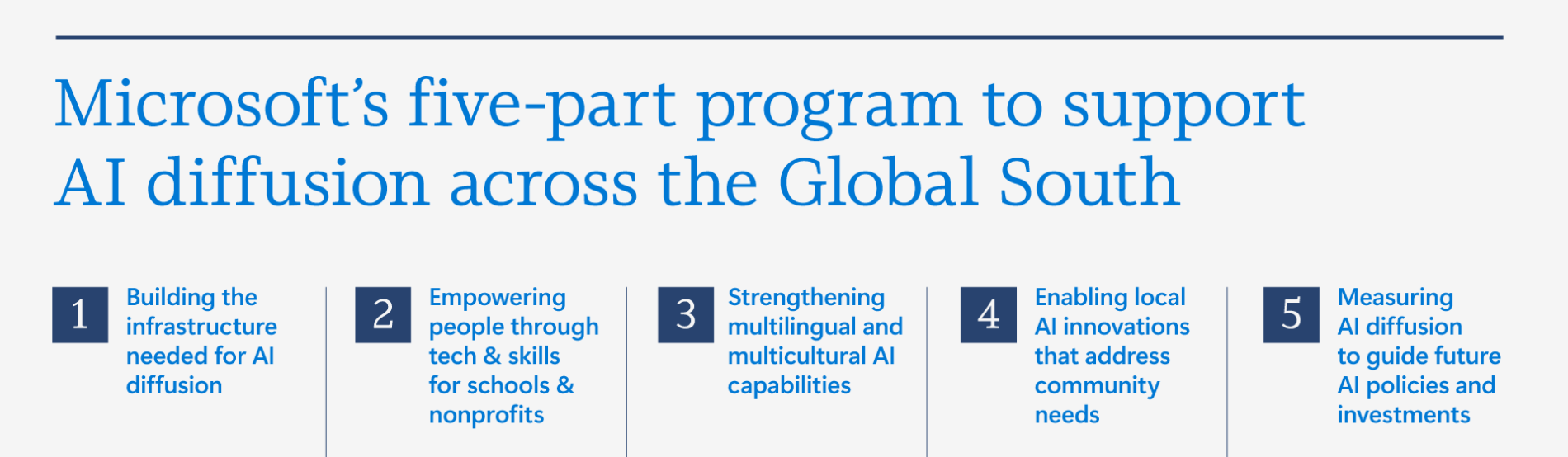
Microsoft announced plans to invest up to USD 50 billion by 2030 to help bridge the AI divide in the Global South — a commitment that includes infrastructure expansion, skills development, and multilingual AI capabilities.
– Alliances
India joined the U.S.-led Pax Silica initiative, which seeks to build a network of like-minded countries, during the AI summit.
– Launch
The submit witnessed the launch of India’s first domestically trained multi-billion-parameter LLMs by Sarvam AI. It’s an open-source platform.
– Voluntary Initiatives
A suite of voluntary, non-binding collaborative initiatives was launched under the New Delhi Declaration on AI Impact — designed to democratise AI access and accelerate adoption:
- Charter for the Democratic Diffusion of AI – affordable access to foundation AI resources.
- Global AI Impact Commons – It’s a platform to scale and replicate AI use cases globally.
- Trusted AI Commons – A repository of tools, benchmarks, and best practices to promote the development of secure and trustworthy AI systems.
- AI Workforce Development Playbook & Reskilling Principles – This supports AI education, such as skilling, reskilling, and literacy, to prepare for an AI-driven economy.
- International Network of AI for Science Institutions – Promotes cross-border, collaborative research agendas by linking scientific and technical institutions.
How AI Impact Summit Matters for Businesses & Technology Services
– AI Investment Increases Demand for Software Innovation
Massive spending commitments mean more need for training, development, initiatives, and innovation opportunities in the field of AI.
– Shared Platforms Lower Barriers to AI Adoption
Initiatives like the Global AI Impact Commons and workforce development frameworks help smaller businesses and IT service providers integrate AI responsibly.
– Trusted AI Resources Support Enterprise-Grade Solutions
The Trusted AI Commons reinforces best practices that businesses should adopt when building secure, compliant, and scalable AI software.
Microsoft AI Technologies in Action at the India AI Impact Summit 2026
At the India AI Impact Summit, Microsoft arrived not just with announcements, but with nine live, real-world. These use cases demonstrated what Microsoft’s Azure AI, Microsoft 365 Copilot, Dynamics 365, and Microsoft Power Platform are already delivering — and what that means for organisations looking to move from AI curiosity to AI capability. Here are the cases demonstrated in the summit:
1. Healthcare and Frontline Operations
- Apollo Hospitals deployed a Clinician Copilot on Azure AI to automate documentation, patient history summaries, and routine administrative tasks — giving physicians more time for actual care.
- Meanwhile, Khushi Baby equipped rural ASHA workers with AI tools for maternal health tracking and multilingual guidance.
- The pattern here — using Copilot to eliminate repetitive knowledge work so that frontline professionals can focus on what matters — is directly replicable in financial advisory, retail customer service, and professional services delivery.
2. Industrial AI and Multi-Agent Systems
- ONGC demonstrated multi-agent AI on Azure, where specialised agents handling geology, equipment data, and drilling performance work in coordination to support complex engineering decisions.
- Tech Mahindra extended this with multilingual agent frameworks across all 22 Indian languages.
- For BFSI and professional services firms, the parallel is clear — multi-agent systems can simultaneously handle credit analysis, compliance checks, customer communication, and risk flagging in coordinated workflows that no single model or human team could manage at the same speed.
3. Serving Citizens at Scale
- Microsoft’s integration of Azure OpenAI into e-Shram — serving 310 million informal workers — is the most dramatic illustration of what AI-powered Business Applications can do when connected to real data and real workflows.
- The system handles multilingual benefit navigation, AI-assisted job matching, and automated guidance at population scale.
- For enterprises in retail, banking, and education, the analogous opportunity is in customer engagement at scale: personalised, multilingual, always-on interactions powered by Copilot and Microsoft Dynamics 365.
4. Enterprise Trust: Copilot and Data Sovereignty
- For regulated industries, Microsoft’s confirmation that Microsoft 365 Copilot now supports in-country data processing in India is a significant unlock.
- BFSI organisations that have been cautious about AI adoption due to RBI, SEBI, or IRDAI compliance considerations now have a viable path forward.
5. Skilling, Education, and the Developer Story
Microsoft’s Copilot modules are aligned to NCERT curriculum outcomes for rural teachers, and GitHub Copilot’s role in upskilling India’s 24 million developers.
6. Research at the Edge: Multilingual and Multimodal AI
- Project Gecko and Microsoft’s Paza speech models — enabling voice-driven AI interactions in local languages on mobile devices — point to where AI interfaces are headed.
- For retail and education businesses serving India’s diverse linguistic base, the ability to engage customers and learners in their own language, through voice or text, is no longer a futuristic aspiration. It is an available capability today, on Azure, ready to be configured and deployed.
Key Takeaway
The AI Impact Summit 2026 marked a defining moment in India’s digital journey, as it was the first of its kind to happen in South Asia. The summit reinforced that AI is no longer confined to research labs — it is becoming foundational to economic growth, enterprise innovation, and public infrastructure. The adoption of the New Delhi Declaration signaled global consensus on inclusive, development-focused AI.
The emphasis moved beyond regulatory debates toward real-world impact — from expanding computing infrastructure and indigenous AI model development to enabling workforce readiness and cross-border collaboration. The summit highlighted India’s ambition to strengthen AI infrastructure, scale enterprise adoption, and build trustworthy AI systems aligned with global standards.
Soluzione IT Services was proud to witness this historic summit alongside global dignitaries and technology leaders. As an Indian IT company focused on Custom Software Development, CRM solutions, IT support, and digital transformation services, we recognise that this summit reflects India’s readiness to contribute meaningfully and responsibly to global AI initiatives.
Sources
AI Impact Summit 2026 Concludes with Adoption of New Delhi Declaration
Press Release: Press Information Bureau
What are the key takeaways from AI summit? We need to act with urgency to address the growing AI divide – Microsoft On the Issues
We need to act with urgency to address the growing AI divide – Microsoft On the Issues
Explore More: News & Updates