Artificial Intelligence (AI) has reimagined the digital ecosystem, redefining how content is understood, how brands are perceived, and how credibility is built in an age of intelligent search and precise results. For most businesses, this approach has also shifted conventional SEO strategies from simply adding keywords and backlinks to a smarter approach. Today, what truly matters is how intelligently your content communicates value, relevance, and trust.
And that’s exactly where schema markup, E-E-A-T, and Geo-targeted content come into play in modern search visibility. Together, they shape how your brand is interpreted, not just by algorithms, but also by real users seeking meaningful, location-relevant, and credible information. And now with AI in SEO, these pillars can generate smarter schema, comprehensively evaluate E-E-A-T metrics with precision, and optimize geo-content in real time based on user intent and context.
In this blog, we’ll explore how AI is transforming Schema, E-E-A-T, and GEO content, and how brands can harness these changes to stay visible, credible, and competitive in the evolving world of AI-powered SEO.
- The New Language of Search: How Schema Empowers AI Interpretation
- E-E-A-T and AI: Establishing Expertise, Experience, Authority & Trust
- GEO Content and Local Context: AI-Driven SEO for Regional Relevance
- Integrating AI-Powered SEO, Schema, E-E-A-T & GEO: A Unified Framework
- Not To Miss: What Comes Next in AI-Empowered SEO
- Final Takeaway
- Frequently Asked Questions
The New Language of Search: How Schema Empowers AI Interpretation
Schema markup, structured data embedded in your HTML, was once seen as a technical afterthought. Now, it’s a foundation of SEO in the age of AI that helps search engines understand content intent, content type, and relationships between entities. But before discussing the concept comprehensively…
1. Why Schema Matters More Than Ever?
When you deploy schema markup correctly, you’re essentially feeding AI-powered SEO systems with signals about what your content intends to convey. Whether it’s an FAQ section, product review, event listing, or local business profile, structured data helps search engines contextualize that information. That clarity makes your content eligible for rich snippets, knowledge graph features, and voice-search enhancements.
2. How AI-based SEO Tools Optimize Schema
Modern AI-powered SEO platforms can automatically scan your website, detect missing schema types, and suggest enhancements. Some tools even generate JSON-LD markup snippets based on your content and its structure. This kind of automation is a prime example of AI-driven SEO at work, where the system suggests schema updates that a human reviewer can validate before deployment.
3. Best Practices for Combining Schema and AI
- Audit what you already have: Use AI-powered SEO crawlers to identify schema gaps.
- Enrich entity relationships: Link the local business schema to the FAQ schema or the review schema to build a richer context.
- Update dynamically: If you publish new pages, feed that data into your AI SEO marketing pipeline so that schema is added automatically.
By integrating schema markup in an AI-optimized SEO workflow, you ensure that your content remains discoverable, eligible for SERP enhancements, and aligned with user intent signals.
E-E-A-T and AI: Establishing Expertise, Experience, Authority & Trust
Search engines now evaluate not just the words you use, but how credible and experientially grounded your content appears. Here’s where AI’s impact on SEO is profound: AI-based systems can help scale and monitor your E-E-A-T signals, while you maintain the human touch behind your expertise and experience.
1. What is E-E-A-T?
Let’s decode the term E–E-A-T:
- Experience: First-hand or user-centric experience demonstrated in content.
- Expertise: Demonstrable subject-matter knowledge.
- Authority: Industry recognition, backlinks, citations.
- Trust: Transparency, accuracy, and user safety.
2. AI’s Role in Reinforcing E-E-A-T
AI-driven SEO platforms can help you evaluate sentiment, factual accuracy, tone, and even authorship credibility. For example, an AI SEO marketing dashboard might flag content with outdated statistics, thin coverage of a topic, or a lack of authoritative references. It can suggest improvements to language to reflect a more authoritative tone or highlight opportunities to link to credible sources.
On the other side, you still need human oversight. Automated checks improve consistency, but they don’t replace subject-matter experts. Rather, AI-powered SEO becomes a collaborator: it enhances your ability to maintain high E-E-A-T across hundreds or thousands of pages, while your editorial team ensures authenticity.
3. Enhancing E-E-A-T with AI-Optimized SEO
- Content reviews: Use AI-based tools to scan for outdated or incorrect information, then task your expert authors to update it.
- Author profiles and credentials: Ensure each author page is structured with schema and metadata so that AI SEO marketing tools can tie content to real, credentialed individuals.
- Review signals: Integrate user reviews or case studies into your content strategy; AI-driven SEO models can aggregate and highlight high-rated feedback in schema-based review snippets.
By combining your human expertise and AI-based insights, you create content that not only ranks well but also earns trust and drives conversions.
GEO Content and Local Context: AI-Driven SEO for Regional Relevance
In an interconnected world, search results often need to be tailored to local context, language, culture, regulations, and user preferences. That’s where GEO content becomes essential. And AI-based SEO tools are now crucial in detecting local trends, optimizing content for specific geographies, and scaling regional versions of your site.
1. How Regional AI SEO Works
When you optimize a global site for domestic users, or vice versa, you must consider variant spellings, cultural references, time-sensitive events, or regional compliance. AI-driven SEO can analyze regional patterns in search volume, suggest locale-specific keywords, and even adjust tone based on demographic data.
2. How to Implement GEO Content with AI-Powered Workflows
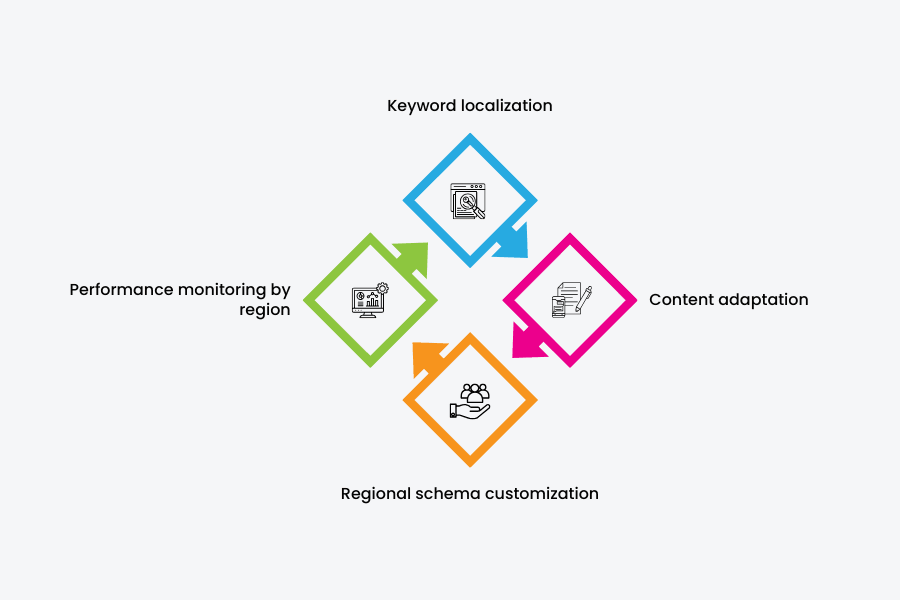
- Keyword localization: AI-powered SEO tools can suggest local search terms that differ from your general high-volume keywords. That ensures you capture searchers who use region-specific phrasing.
- Content adaptation: Instead of simply translating a page, AI-optimized SEO pipelines help you tailor imagery, cultural references, and examples that resonate with a specific geography.
- Regional schema customization: For example, a business address schema or opening hours schema might differ by country or state. AI-driven SEO processes can generate schema variants based on GEO metadata.
- Performance monitoring by region: Use AI-based SEO dashboards to compare traffic, engagement, bounce rate, and conversions across geographies. That data feeds into iterative improvements of your localized content.
By embedding local intelligence into your AI SEO marketing strategy, you achieve higher relevance for your target audience and stronger performance in local search.
Integrating AI-Powered SEO, Schema, E-E-A-T & GEO: A Unified Framework
To succeed in SEO in the age of AI, you need a coherent framework that unites all these components. Below is a high-level approach to integrating AI-powered SEO, schema markup, E-E-A-T compliance, and GEO content targeting:
| Step | Focus | Why It Matters |
| Audit & Benchmark | Use AI-based SEO tools to discover existing schema gaps, E-E-A-T weak spots, and regional traffic trends | Establishes baseline and priorities |
| Define Taxonomy & Schema Strategy | Map content types to appropriate schema (articles, reviews, local business, FAQ, events, etc.) | Enables AI-driven SEO automation and consistency |
| Author & Credibility Program | Build author profiles, credential pages, case studies, and citations to reinforce E-E-A-T | Boosts trust and search visibility |
| Local / Geo Strategy | Create region-specific versions of key pages; use AI analytics to identify high-potential GEO opportunities | Improves relevance and conversion for local audiences |
| Content Production with Human-AI Partnership | Generate drafts, optimize headings, validate schema, ensure accurate references, and apply local context | Blends the efficiency of AI with the authority of humans |
| Continuous Monitoring & Feedback Loop | Monitor SERP performance, user behavior, and update AI-SEO model suggestions accordingly | Iterative improvements maintain alignment with evolving search algorithms |
This unified framework ensures that your marketing in the age of AI is not fragmented. Rather, it becomes a living system where AI in SEO empowers your team to deliver trustworthy, structured, and locally resonant content at scale.
Not To Miss: What Comes Next in AI-Empowered SEO
Looking ahead, AI in SEO will continue to evolve, and so should your strategy. Here are a few emerging trends to keep on your radar:
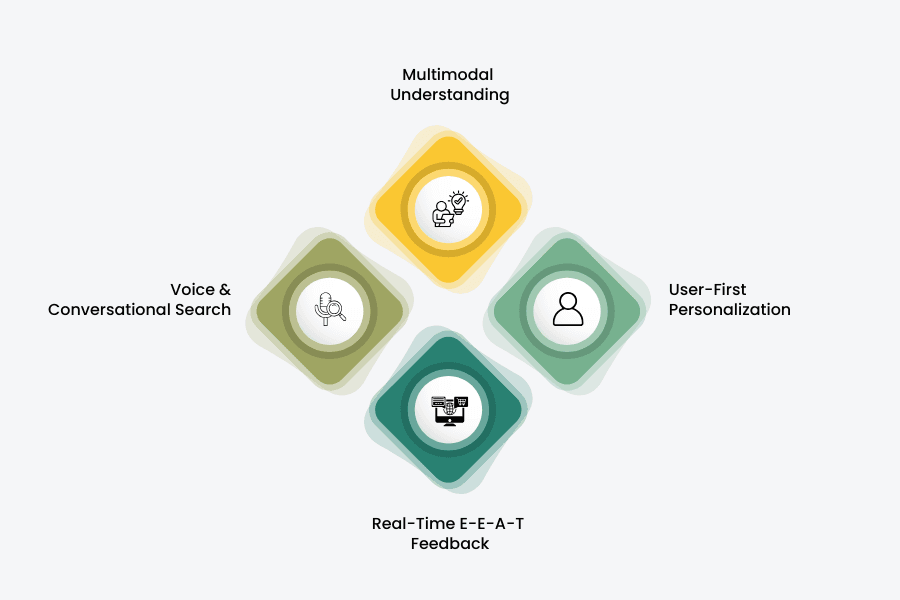
1. Multimodal Understanding:
AI-powered SEO tools will increasingly understand images, video transcripts, and audio content in addition to text, and schema standards may expand accordingly.
2. User-First Personalization:
GEO content may become hyper-localized not just by city, but by micro-segment (e.g., neighborhood, demographic group). AI-driven SEO recommendations will reflect that granularity.
3. Real-Time E-E-A-T Feedback:
As regulations shift and new data appear (e.g., updated medical or financial guidance), AI-based SEO systems will flag content in real time for review and refresh.
4. Voice & Conversational Search:
With search increasingly happening via voice assistants and chatbots, schema plus E-E-A-T credentials plus local context will matter even more to secure featured snippets or spoken-response answers.
Final Takeaway
To succeed with SEO in the age of AI, you must adopt AI-optimized SEO practices, not as an experiment, but as a core part of your marketing architecture. That means treating schema markup as living metadata, treating E-E-A-T as a performance metric, and treating GEO content as a dynamic signal that reflects your audience’s diversity.
When you align human expertise with AI-powered SEO tools and processes, you unlock the capacity to produce scalable, credible, and contextually relevant content. And that is precisely what marketing in the age of AI demands.
To meet this demand, you can partner with the SEO experts at Soluzione, who utilize their best AI-SEO practices to scale your business, digitally and organically. We at Soluzione not only tap into markets that encourage the latest technologies, but also marketing strategies that attract the target audience like never before.
Our personalized consultation call will help you get to know us better- Book a Free Call Now!
Read More: https://www.solzit.com/blog/
Frequently Asked Questions
How does GEO-targeted content help brands connect with local audiences?
GEO-targeted content helps the local audience connect with more relevant answers to their search queries. It helps businesses achieve better engagement with their local audience and attracts higher traffic, without complicating search results.
Can AI tools help optimize E-E-A-T signals like expertise and trustworthiness?
AI tools may not directly assist businesses with E-E-A-T optimization, but they serve as a support system for developing E-E-A-T strategies. It eventually helps them build digital credibility and trustworthiness through content that combines genuine human experiences with AI-integrated, advanced techniques.