On August 25, 2026, Microsoft announced a major shift in how it shares upcoming capabilities. The familiar twice-yearly Release Wave 1 and Release Wave 2 model is being retired in favor of continuous publishing through the AI at Work roadmap.
Release Planner has now been fully retired on November 15, 2026. From that point, the AI at Work roadmap becomes the primary public destination for roadmap information. In this guide, we will share comprehensive information on why this shift happened, what the new AI at Work Roadmap is, and how to prepare.
What’s Changing and When
| When | What’s Changing |
| September 2026 | New Dynamics 365, Microsoft Power Platform, and Microsoft Dataverse capabilities begin appearing on the AI at Work roadmap as soon as plans are committed. |
| September to November 2026 | Existing roadmap items with a public preview or general availability date of June 1, 2026 or later move across. Updates are shared via Message Center. |
| November 15, 2026 | The transition completes and Release Planner retires. |
There will be no September 2026 Release Wave 2 announcement or release plan. New capabilities are now shared continuously instead of being held for the next wave.
What This Means For Users
Earlier Visibility
Most capabilities appear on the roadmap sooner than they would have under the old wave calendar.Continuous Tracking
Each item stays visible and updated as it moves through In Development → Rolling Out → Launched, so you can follow progress all the way to delivery.One Unified View
Dynamics 365 services, Power Platform, Dataverse, Microsoft 365, Microsoft Copilot, and custom agents built in Copilot Studio now share a single destination. You can filter by the products and environments that matter to your organization and plan across the portfolio.Also Check: Microsoft 2026 Release Wave 1 Plan: What You Should Know?
What is the AI at Work Roadmap?
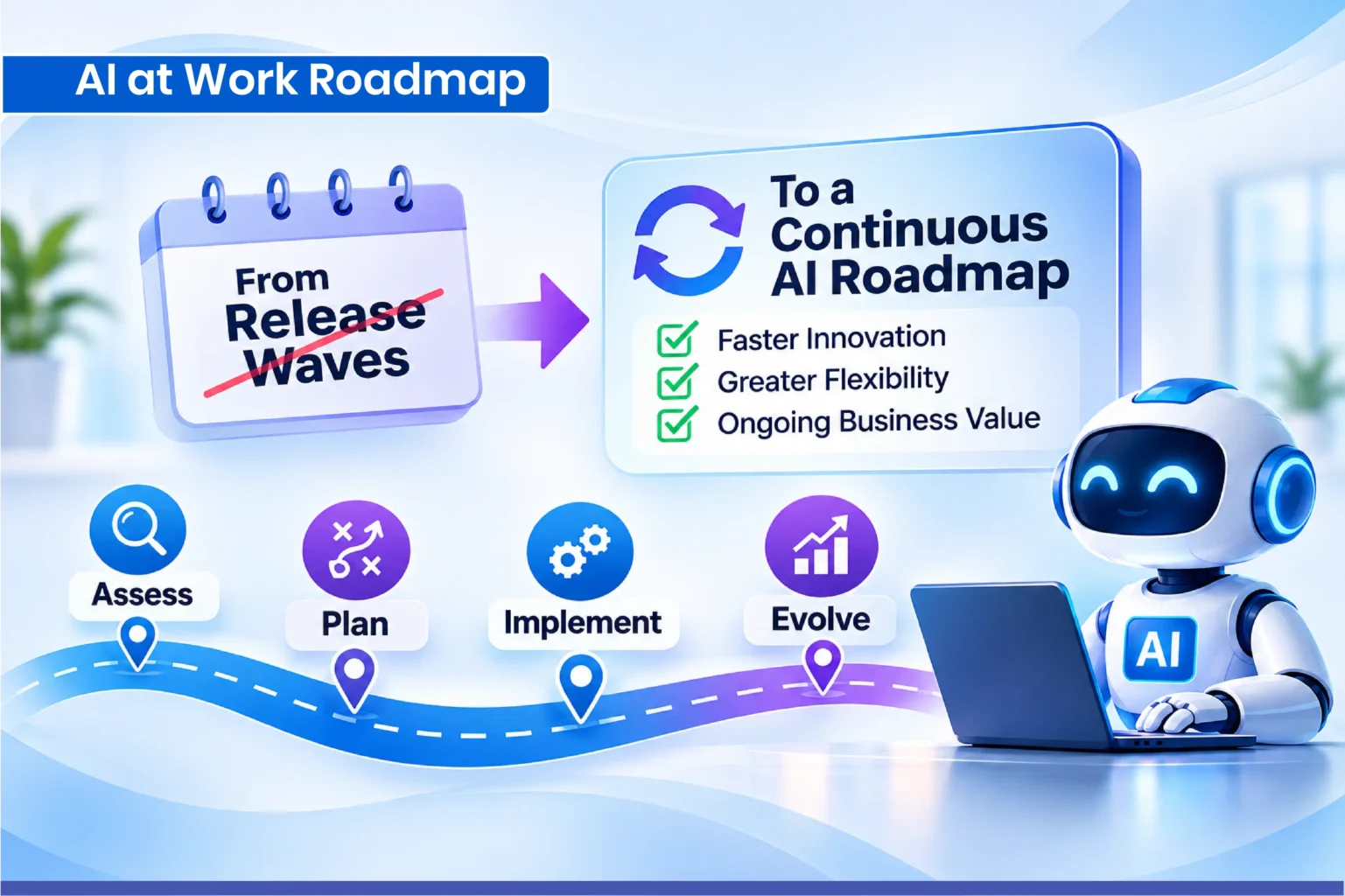
The AI at Work roadmap is Microsoft’s unified public roadmap, formerly known as the Microsoft 365 roadmap, updated to reflect its broader scope. Starting September 2026, Dynamics 365, Microsoft Power Platform, and Microsoft Dataverse content will join Microsoft 365 and Copilot, giving you one destination to discover upcoming capabilities, track rollout progress, and plan adoption across Microsoft’s business applications, productivity, and AI portfolio.
Unlike the old wave documents, it is built for planning. New capabilities are published as soon as plans are committed, and each item stays current as it moves through In Development → Rolling Out → Launched. Microsoft has also confirmed that this changes only how roadmap information is communicated, not how its products are built, released, or deployed. Release Plans on Microsoft Learn stop publishing from September 2026 but remain available as an archive for historical reference.
How to Work with the AI at Work Roadmap
- Step 1. Filter views to the products and cloud environments that matter most to your organization.
- Step 2. Export complete or filtered views to a CSV file.
- Step 3. Subscribe to updates via RSS.
- Step 4. Share roadmap links directly with stakeholders.
- Step 5. Search and organize content using feature IDs and advanced filters.
Alternatively, the Release Communications MCP Server lets you pull roadmap data directly into your own AI tools and workflows. Organizations can generate customized views, planning materials, or integrate the data into existing processes.
How To Prepare for AI at Roadmap
- Spend a few minutes exploring the AI at Work roadmap and set filters for the products and environments you use.
- Subscribe to RSS updates for your filtered views, and continue using Message Center for tenant-specific changes.
- Update any release plan links, bookmarks, or internal documentation to point to the AI at Work roadmap. Guidance will be available during the transition.
- Create your own review rhythm (monthly or quarterly) based on a saved filter and RSS subscription. The old waves gave fixed planning moments twice a year — now you set the cadence that fits your adoption speed.
What’s Remain Unchanged
- Products with established release schedules continue to follow those schedules.
- Message Center remains the source for tenant-relevant change notifications.
- Microsoft Learn continues as the home for product documentation and implementation guidance.
Summing Up
AI in Work Roadmap marks Microsoft’s shift from twice-yearly “big drop” announcements to a continuous, always-current view of what’s coming. This shift enables earlier insight, clearer tracking, and simpler cross-product planning for users.
At Soluzione, as a Microsoft Solutions Partner, we’re already helping clients adapt their planning processes to the new AI at Work roadmap. If you’d like support reviewing the roadmap for your environment, setting up filters and subscriptions, or aligning your adoption roadmap, we’re here to help — just reach out.
Read More: Blogs & Articles, News & Updates, Case Studies
Frequently Asked Questions
Why did Microsoft introduce Release Waves for Dynamics 365?
Microsoft introduced the Release Wave model (around 2018, with roots going back further) to bring structure, predictability, and trust to the shift toward a continuous cloud service. The waves created a shared rhythm: Release Wave 1 (April–September) and Release Wave 2 (October–March), each accompanied by detailed release plans.
What are the benefits of Microsoft's evolving release strategy?
The move from fixed Release Waves to continuous publishing via the AI at Work roadmap brings several practical advantages:
- Earlier visibility: New capabilities appear as soon as Microsoft commits to them, instead of being held until the next wave announcement.
- Continuous tracking: Items stay visible and are updated as they progress through In Development → Rolling Out → Launched, so teams can follow progress all the way to delivery.
- One unified view: Dynamics 365, Power Platform, Dataverse, Microsoft 365, Copilot, and related AI experiences are now in a single destination. Organizations can filter by the products and environments they actually use and plan across the full stack.
- Better alignment with real work: Most companies use these products together. A single roadmap matches how customers operate and reduces the need to stitch together multiple separate plans.
- Greater flexibility: Teams can set their own review cadence (monthly or quarterly) instead of being tied to two fixed moments per year.
How can businesses prepare for future Microsoft updates?
Microsoft recommends a few practical steps during and after the transition:
- Explore the AI at Work roadmap and set filters for the specific products and cloud environments your organization uses.
- Subscribe to RSS feeds for your filtered views so updates come to you automatically.
- Continue using Message Center for tenant-specific change notifications.
- Update internal links, bookmarks, and documentation that previously pointed to release plans or Release Planner.
- Establish your own recurring review rhythm (monthly or quarterly) based on a saved filter and RSS subscription. The old waves provided natural checkpoints; now organizations need to create their own.
- Use the Release Communications MCP Server if you want to pull roadmap data directly into AI tools or internal planning systems.
- Export filtered views to CSV when needed for stakeholder reviews or documentation.
These steps help teams stay proactive without relying on the previous twice-yearly planning moments.
Why is Microsoft changing its release approach in 2026?
Microsoft is changing the approach for two main reasons, as stated in the official August 25, 2026 announcement:
- How customers actually work: Few organizations run Dynamics 365, Power Platform, Microsoft 365, or Copilot in isolation. Bringing roadmap content into one place makes it easier to see what is coming across the full portfolio, filter it to the relevant environment, and plan adoption holistically.
- The need for continuous, timely information: Holding new capabilities until the next scheduled wave no longer matches the pace of innovation, especially with rapid advances in AI and agents. Continuous publishing lets Microsoft share plans as soon as they are ready, and keeps each item current as it moves through development and rollout.
In short, the old wave model served its purpose of building trust and predictability during the transition to cloud. The new always-on AI at Work roadmap better supports the interconnected, AI-driven way organizations use Microsoft products today.