Technology is transforming the way businesses develop and manage digital products. From how code is written to how it’s secured and deployed, the software landscape is changing at an incredible pace. In 2026, software development services will be more intelligent, collaborative, and automated than ever before.
Artificial Intelligence (AI) is now helping developers write, test, and optimize code. Low-code tools are opening the door to faster, more accessible app development. Meanwhile, DevSecOps is ensuring that security is integrated from the very beginning of every project. These changes are redefining how software development companies deliver value to clients.
Whether through .NET Core development or other advanced development technologies, the industry is heading toward smarter, faster, and safer software. In this blog, we will explore the top trends that will dominate software development in 2026.
7 Software Development Trends to Follow in 2026
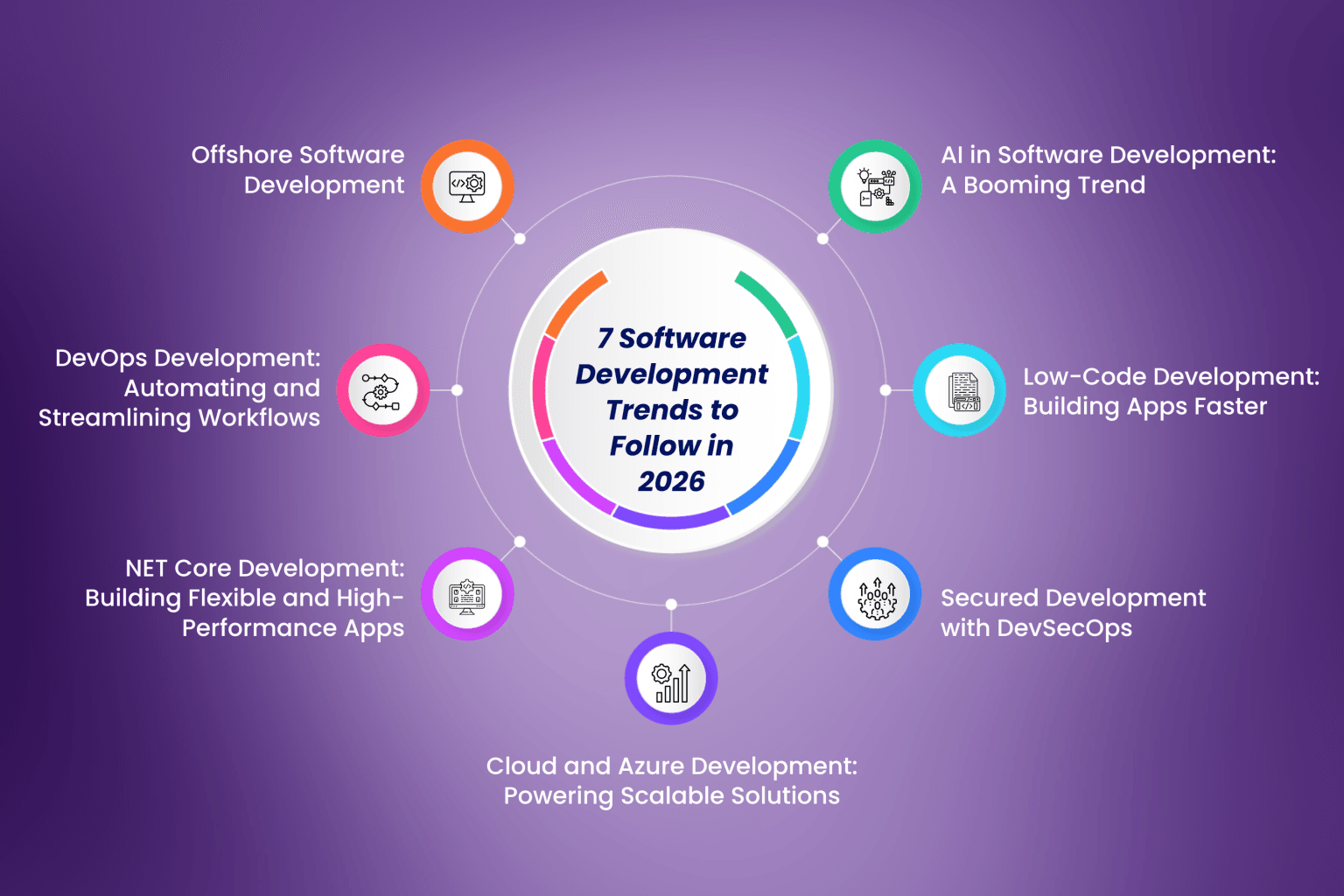
1. AI in Software Development: A Booming Trend
AI is becoming a core part of modern software development services. In 2026, developers will be seen utilizing artificial intelligence as a team player that supports them throughout the lifecycle, from writing cleaner code to automating testing and deployment.
AI-based assistants like GitHub Copilot and ChatGPT-style code helpers are transforming how custom software development is done. They reduce human error, speed up delivery, and improve overall code quality. For eg, a software development company using AI can also analyze user behavior to make apps more personalized and efficient.
This trend is especially powerful for offshore software development teams, where AI tools help maintain quality and consistency across time zones and distributed teams. With such AI’s growing capabilities, 2026 will see more automation in code generation, project estimation, and bug detection.
2. Low-Code Development: Building Apps Faster
Businesses no longer have to depend only on large engineering teams for every project. With low-code development, anyone with basic technical knowledge can create applications quickly using pre-built templates and drag-and-drop tools.
In 2026, most top software development agencies will be seen combining low-code tools with custom software development strategies to strike the perfect balance between speed and flexibility. In fact, according to Future Market Insights, “the global low-code development platform market is projected to grow from ~ US$35.2 billion in 2025 to very large numbers by 2035 (CAGR ~21%).” This approach allows companies to test ideas faster and bring products to market sooner without sacrificing quality or scalability.
For example, a software development company can use low-code tools to build rapid prototypes and then integrate advanced features using .NET Core or Azure development. This combination ensures faster turnaround, reduced costs, and efficient collaboration between developers and business teams.
3. Secured Development with DevSecOps
Security breaches are becoming increasingly frequent and costly for businesses, often resulting in substantial losses. Hence, undoubtedly, in 2026, DevSecOps will continue to dominate the software development industry evern more then before. This is because, unlike traditional models, DevSecOps embeds security directly into the development pipeline instead of integrating it later.
A software development company following DevSecOps practices can integrate continuous security testing, automated vulnerability scanning, and compliance checks into its DevOps workflows. This ensures every code update is checked not only for how it works but also for its security.
4. Cloud and Azure Development: Powering Scalable Solutions
Talking about–in future, Microsoft Azure development will play a major role in helping businesses scale, automate, and secure their digital operations.
With its advanced AI tools, data analytics, and integration capabilities, Microsoft Azure is becoming the go-to choice for enterprise-grade applications. As per reports “In a more recent earnings report, Microsoft’s Intelligent Cloud unit (which includes Azure) saw its revenue increase by 21%, with Azure and other cloud services up ~34% in that period”. Utilizing these exceptional technologies can help businesses migrate legacy systems, build cloud-native apps, and enable real-time data processing.
For offshore software development teams, Azure simplifies collaboration by offering shared environments, remote deployment tools, and automatic version control. It’s an essential part of how companies are modernizing their software infrastructure in 2026.
5. .NET Core Development: Building Flexible and High-Performance Apps
.NET Core development remains one of the most reliable frameworks for building robust, cross-platform applications. It allows developers to build scalable and high-performing solutions that run seamlessly across Windows, macOS, and Linux.
In 2026, most businesses and software development companies will continue using .NET Core for enterprise systems, cloud-based applications, and API-driven projects. In fact, reports claim “Because .NET Core (modern .NET) works very well in cloud-native setups, with cross-platform support (Linux, Windows) and strong performance, it’s a natural fit for building microservices, APIs, and cloud apps”. The framework’s integration with Azure and its strong security features even make it a top choice for global businesses.
When combined with DevOps development practices, .NET Core simplifies continuous integration and deployment. This helps software developers have faster updates on the development process while ensuring consistent performance and quality across platforms.
6. DevOps Development: Automating and Streamlining Workflows
DevOps development focuses on collaboration between developers and operations teams to improve delivery speed and reliability. In the future, automation tools will continue to enhance how software development services are managed.
CI/CD (Continuous Integration and Continuous Deployment) pipelines will become more intelligent with AI-driven testing and predictive analytics. This means faster feedback loops, fewer bugs, and smoother deployments.
Businesses using DevOps best practices will find that code moves from development to production with minimal manual effort. For offshore software development models, DevOps also helps teams stay synchronized and maintain quality across different environments.
7. Offshore Software Development
According to a report by Business Research Insights, the global offshore software development market was valued at USD 178.6 billion in 2025, and is projected to reach USD 198.3 billion in 2026 says report. This report is a clear indication that the future is about an exponential rise in offshore software development as companies seek skilled talent at competitive costs.
Businesses now prefer working with the best software development agencies that offer a hybrid model, combining an onshore strategy with offshore execution. This approach delivers round-the-clock productivity, better resource management, and access to specialized skills.
With advanced collaboration tools and DevSecOps practices, offshore software development has become more secure, transparent, and efficient than ever before.
Final Words
2026 is shaping up to be a turning point for the software industry. With AI improving development speed, low-code platforms simplifying complex workflows, and DevSecOps embedding security at every stage, software is becoming smarter, faster, and more dependable. Businesses that adapt to these shifts will not only stay competitive but also set new standards for digital innovation.
At Soluzione, we help companies build future-ready software using modern technologies, efficient workflows, and secure architectures. Our developers stay ahead of every emerging trend, adopting the latest tools and practices so your business never falls behind in the fast-changing world of technology.
From strategy to deployment, our team ensures your ideas turn into powerful, scalable, and sustainable digital solutions that lead in tomorrow’s market. To know more- Book your call with us now!
Read More: https://www.solzit.com/blog/
FAQs:
How is Artificial Intelligence (AI) changing software development?
AI is transforming software development by automating coding, testing, and debugging processes. It helps developers predict errors, optimize performance, and personalize user experiences. AI-powered tools like GitHub Copilot and ChatGPT are speeding up development cycles and improving overall software quality.
What is Low-Code development, and why is it gaining popularity?
Low-code development allows developers and non-developers to build applications using visual interfaces instead of complex coding. It’s gaining popularity because it reduces development time, minimizes costs, and enables rapid prototyping, helping businesses adapt faster to market changes.
How does DevSecOps improve software security and efficiency?
DevSecOps integrates security into every stage of the development process. It ensures that vulnerabilities are detected and resolved early, reducing risks and improving overall efficiency. This continuous security approach helps teams deliver safer software without slowing down development.
How can businesses leverage Low-Code platforms for faster innovation?
Businesses can use Low-Code platforms to quickly build and deploy applications, test new ideas, and automate workflows without depending heavily on IT teams. This accelerates digital transformation, empowers innovation, and keeps companies competitive in a fast-evolving tech landscape.