As cloud adoption accelerates and Microsoft shifts deeper into an AI-first strategy, choosing the right Microsoft solution partner has become a critical business decision rather than a simple vendor selection. With the retirement of legacy Gold/Silver competencies and the rollout of the Microsoft AI Cloud Partner Program (MAICPP), partners are now evaluated on actual capability — measured through Partner Capability Scores, customer success metrics, and proven delivery across Microsoft’s six solution areas.
Whether you are modernizing legacy systems, deploying enterprise applications, or strengthening security across your IT landscape, the partner you select can directly influence your project outcomes, user experience, and long-term digital maturity. With thousands of IT service providers and US tech solutions companies claiming expertise in Microsoft technologies, the challenge is identifying which partner is genuinely aligned and capable of supporting your business roadmap.
This guide outlines a structured, practical approach for evaluating and selecting a Microsoft solutions partner that aligns with your technical needs, business priorities, and future goals.
Why Your Choice of Microsoft Solution Partner Matters?
Microsoft’s ecosystem is vast, spanning Azure, Dynamics 365, Power Platform, Microsoft 365, cybersecurity workloads, and industry-specific cloud offerings. Implementing these solutions requires more than tool knowledge; it requires a deep understanding of enterprise workflows, compliance requirements, integration patterns, scalability needs, and change management.
A qualified Microsoft solution partner helps you:
- Turn Microsoft’s technologies into IT solutions for businesses that deliver measurable impact.
- Build modern, secure infrastructures that scale with evolving demands.
- Optimize licensing, reduce unnecessary cloud spending, and improve operational efficiency.
- Adopt Microsoft innovations faster than competitors.
- Improve collaboration and productivity for distributed teams.
- Ensure governance and security remain intact as your digital estate expands.
In short, the right partnership can transform your investments into strategic assets, while the wrong one can stall digital transformation, drain budgets, and create long-term technical debt.
A Structured Roadmap to Choosing the Right Microsoft Solution Partner
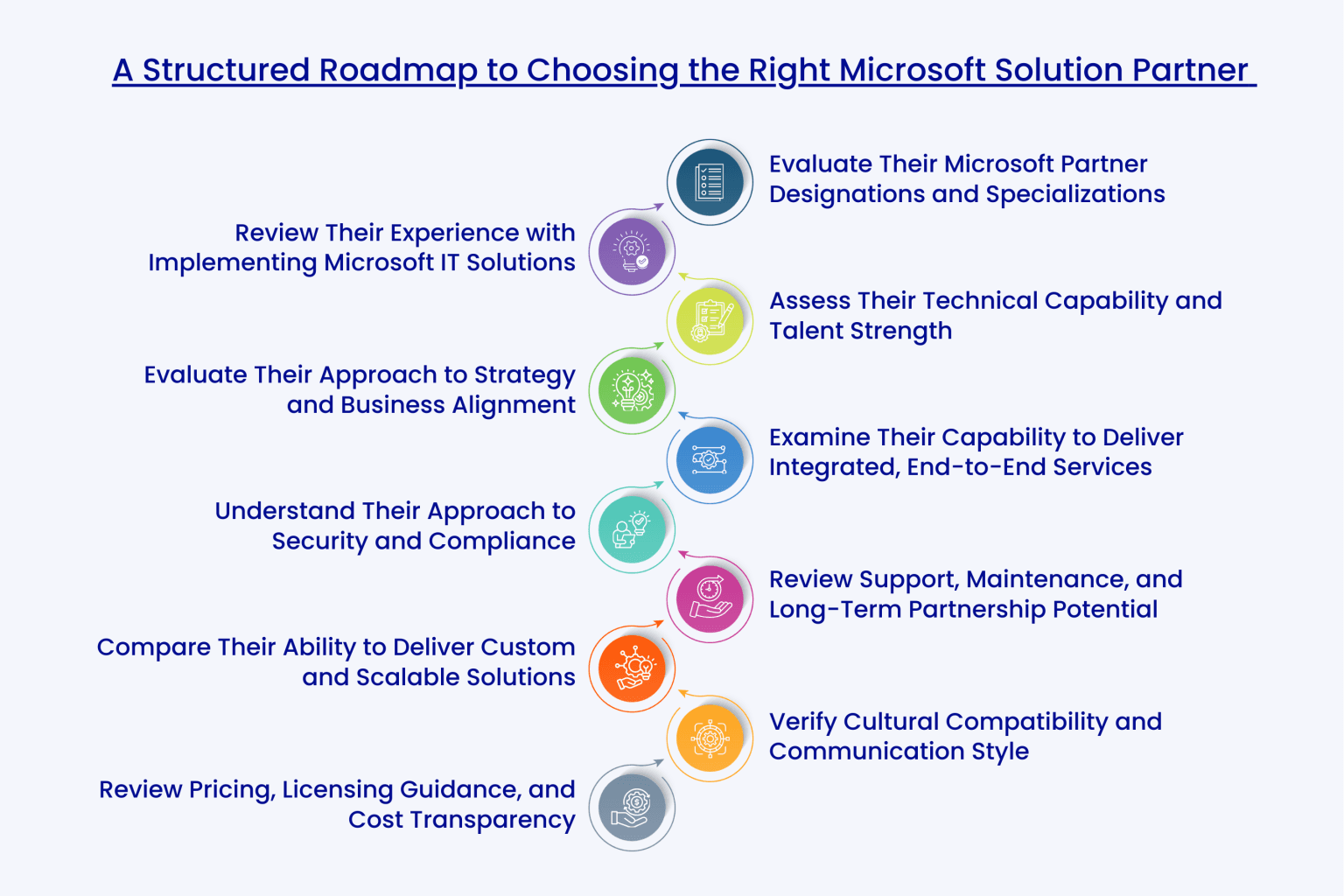
Choosing a Microsoft solution partner is a pivotal step in your digital transformation journey. The right partner can elevate efficiency, strengthen security, and translate Microsoft technologies into real business value. To help you make a confident, well-informed decision, the steps below outline what truly matters when evaluating potential partners.
Step 1: Evaluate Their Microsoft Partner Designations and Specializations
Microsoft recently revamped its partner ecosystem, introducing new Microsoft solution partner designations that reflect a company’s maturity, customer success rate, and technical capabilities. These designations are not symbolic badges; they indicate that a partner has demonstrated competence across core solution areas such as:
- Data & AI (Azure)
- Infrastructure (Azure)
- Digital & App Innovation
- Security
- Modern Work
- Business Applications
When evaluating enterprise IT solutions providers, ensure they hold relevant designations for the workloads you intend to deploy. For instance:
- If you plan to migrate to Azure, the partner must excel in Infrastructure or Data & AI.
- For CRM modernization, a Business Applications designation is essential.
- For workplace transformation, look for Modern Work expertise.
Designations show the partner has proven experience, trained consultants, validated implementation methodologies, and successful customer case studies.
Step 2: Review Their Experience with Implementing Microsoft IT Solutions
A strong Microsoft solutions partner should bring real-world experience across multiple industries and business sizes. This is critical because Microsoft technologies, while powerful, need contextual customization to generate value. Ask partners to provide:
- Documented case studies
- Industry-specific examples
- Project metrics and measurable outcomes
- Comparisons between pre-and post-implementation performance
- User adoption numbers and customer satisfaction scores
Their track record will show whether they can convert technical expertise into Microsoft IT solutions that work in real operational environments. If you serve regulated industries, finance, healthcare, utilities, or government, verify that they have experience navigating compliance mandates in those domains.
A partner capable of delivering tailored IT solutions for Microsoft users will not adopt a one-size-fits-all approach; instead, it will begin with discovery and mapping your workflows before proposing any architecture.
Step 3: Assess Their Technical Capability and Talent Strength
The depth of a partner’s technical team determines the quality and reliability of your implementation. Always review:
- Number of certified Microsoft professionals on their team
- Level of certifications (Associate, Expert, Specialty)
- Specialized architects for cloud, security, and industry solutions
- Dedicated teams for support, maintenance, and monitoring
If the partner also operates as a US tech solutions provider or has global delivery centers, this indicates they have scalable teams capable of handling complex, multi-phase transformation programs.
You should ensure that the partner has strong capabilities in:
- Azure architecture and governance
- Security and compliance frameworks
- DevOps and automation
- Data engineering and analytics
- Integration between Microsoft and non-Microsoft systems
- Application modernization and cloud-native development
A truly competent IT service provider maintains proactive training programs to stay aligned with Microsoft’s rapidly changing roadmap.
Step 4: Evaluate Their Approach to Strategy and Business Alignment
Technology is only one half of the equation. A mature Microsoft solution partner also understands business change management, operational risk, user behavior, adoption barriers, and long-term scaling costs.
During initial conversations, observe whether the partner:
- Asks about your business model and revenue drivers.
- Understands your industry landscape and competitive pressures.
- Evaluates current pain points before recommending any tools.
- Determines ROI measures before proposing a solution.
- Prioritizes business outcomes over technical features.
This level of strategic depth separates a true partner from a transactional vendor. Your ideal partner will shape IT solutions for businesses that accelerate growth, improve processes, elevate customer experience, and enhance internal productivity, not simply deploy software.
Step 5: Examine Their Capability to Deliver Integrated, End-to-End Services
Modern enterprises require solutions that are interconnected across cloud, data, security, workplace collaboration, and applications. Therefore, select a Microsoft solutions partner that supports end-to-end service delivery, including:
- Consulting and technology assessments
- Implementation and customization
- Data migration and integration
- Azure architecture, governance, and FinOps
- Security consolidation and threat protection
- Ongoing support and managed services
Partners offering comprehensive enterprise IT solutions reduce dependency on multiple vendors, minimize integration issues, and accelerate go-live timeframes. They deliver unified services, improve knowledge retention, and ensure consistent quality across all Microsoft workloads.
Step 6: Understand Their Approach to Security and Compliance
Security must be the backbone of all Microsoft IT solutions, especially when dealing with hybrid infrastructures or multiple SaaS platforms. A competent partner should demonstrate expertise in:
- Microsoft Defender security stack
- Entra ID identity and access management
- Zero Trust frameworks
- Data loss prevention and governance
- Regulatory compliance (GDPR, HIPAA, SOC, ISO)
- Secure multi-cloud architecture
Strong security proficiency ensures that your IT solutions for Microsoft users remain resilient against evolving cyber threats. Additionally, request a security architecture blueprint to understand their methodology for protecting critical assets.
Step 7: Review Support, Maintenance, and Long-Term Partnership Potential
Your relationship with a Microsoft solution partner continues well after deployment. The partner should offer multi-tiered support models, including:
- 24/7 monitoring and incident resolution
- SLA-based response times
- Periodic health checks
- Proactive optimization
- Roadmap planning aligned with Microsoft releases
Reliable post-implementation support is significant for businesses running mission-critical workloads such as ERP, CRM, or cloud infrastructure. A strong partner ensures that your IT solutions remain optimized, secure, and scalable as your organization evolves.
Step 8: Compare Their Ability to Deliver Custom and Scalable Solutions
Every business requires some level of customization to ensure that the implemented solution aligns with internal processes. Whether you need custom applications, integrated dashboards, automated workflows, or industry-aligned templates, your partner should have demonstrable skills in:
- Power Platform development
- Modern application development on Azure
- API and integration frameworks
- Automation using Power Automate or Azure services
- Customized deployment strategies
Future scalability is equally important! Your partner should provide a clear architectural vision of how your enterprise IT solutions can expand as your organization grows.
Step 9: Verify Cultural Compatibility and Communication Style
A successful engagement relies on seamless communication, transparency, and collaboration. During the evaluation stage, check whether the partner:
- Provides frequent updates
- Explains technical concepts in business language
- Maintains transparent project management
- Adapts to your communication preferences
- Shows agility during changing requirements
Partners with a collaborative work culture, often visible in leading US tech solutions companies, tend to deliver smoother implementations and better alignment with your internal teams.
Step 10: Review Pricing, Licensing Guidance, and Cost Transparency
Microsoft licensing can be complex! A capable IT service provider simplifies licensing, optimizes costs, and ensures you get maximum value without over-purchasing.
Look for transparency and clarity in:
- Implementation pricing models
- Licensing guidance
- Infrastructure cost estimates
- Long-term ownership costs
- Managed service fees
Your partner should help you choose cost-effective IT solutions for Microsoft users that don’t compromise functionality or security.
Final Thoughts
Choosing the right Microsoft solution partner is a strategic investment, not a one-time project decision. The ideal partner should understand your business vision,demonstrate verified Microsoft expertise, and deliver scalable, secure, and future-ready enterprise IT solutions. Whether you are evaluating local firms or established US tech solutions providers, it is essential to prioritize alignment, capability, transparency, and long-term value.
At Soluzione, these principles guide every engagement. For more than a decade, Soluzione has consistently operated as a Microsoft Gold Partner, a recognition held until August 2025. While, In November 2025, Soluzione earned the Microsoft Solution Partner designation in Data and AI (Azure), reflecting our continuous investment in skills, customer success, and delivery excellence across Microsoft cloud technologies.
Beyond Microsoft, Soluzione holds ISO certifications, is registered under MSME, and adheres to standardized delivery practices that emphasize quality, security, and compliance. All these validations reinforce its commitment to building solutions that deliver measurable value, whether in cloud modernization, Dynamics 365, Power Platform, data and AI, or ongoing managed services. And if you want a verified, trusted Microsoft partner to be with you in digital growth, then lets connect to deliver you same expertise and quality!
Read More: https://www.solzit.com/blog/
Frequently Asked Questions
How to evaluate whether a Microsoft Solution Partner is certified or qualified?
You can evaluate a partner’s qualification by checking whether they hold official Microsoft Solution Partner designations, workload-specific badges, and consultant-level certifications. These recognitions confirm that the partner meets Microsoft’s performance, capability, and customer success criteria. Additionally, reviewing their certified professionals, customer case studies, and demonstrated experience with Microsoft cloud services helps verify their genuine expertise.
What are the key competencies to look for when choosing a Microsoft partner?
Key competencies include:
- Expertise in Azure, Dynamics 365, Power Platform, and Microsoft 365
- Proven success in delivering secure, scalable cloud and application solutions
- Strong integration capabilities across Microsoft and non-Microsoft systems
- Experience with governance, compliance, and modernization initiatives
- Ability to provide end-to-end services, from consulting to deployment and support
These competencies indicate that the partner can deliver high-quality, future-ready solutions aligned with your business goals.
How important is industry experience when selecting a Microsoft Solution Partner?
Industry experience is critical because every sector has unique regulatory requirements, operational workflows, and data complexities. A partner with industry-specific knowledge can design solutions that align with your compliance needs, business processes, and customer expectations. This reduces implementation friction, accelerates adoption, and ensures the solution fits your environment rather than forcing you into generic templates.
How do Microsoft partner specializations influence a project's outcomes?
Microsoft partner specializations directly impact project success because they reflect deep, validated expertise in specific solution areas, such as security, data & AI, cloud infrastructure, or business applications. Partners with specializations bring refined methodologies, skilled teams, and proven frameworks that lead to faster implementations, fewer errors, stronger security, and more strategic use of Microsoft technologies. As a result, projects achieve higher performance, better scalability, and long-term value.