From more than 15 years of software excellence to CMMI Maturity Level 3 success, Soluzione IT Services has successfully taken the flexible, passionate engineering culture that fueled our growth and reinforced it with world-class, organization-wide operational discipline.
Over the years, we have built a reputation as a trusted IT services partner, delivering high-stakes software solutions to large corporate clients worldwide. Along the way, we earned ISO certifications (9001:2015, 27001, 14001:2015, 45001:2018 and 50001), progressed from Microsoft Gold Partner to Microsoft Solutions Partner in Data & AI (Azure) and Digital & App Innovation (Azure), and maintained a disciplined Software Development Life Cycle. As technology and client needs scaled, we recognized the need for a stronger institutional structure. That recognition led us to pursue and achieve CMMI Maturity Level 3 (Defined) certification, a recognition awarded through rigorous appraisal by the CMMI Institute (a subsidiary of ISACA).
What Does CMMI Maturity Level 3 Mean?
The Capability Maturity Model Integration (CMMI) Level 3, known as the “Defined” maturity level, recognizes organizations that have established well-documented, standardized, and consistently followed processes across project management, software development, quality assurance, and service delivery. This recognition certifies that the processes are proactively managed using a clear understanding of interrelationships, and projects tailor those standards to their specific needs while contributing lessons and assets back to the organization. Appraisals follow strict guidelines set by the CMMI Institute / ISACA.
At this level, the organization moves beyond project-by-project management (Level 2) to organization-wide consistency, enabling greater predictability, transparency, and continuous improvement.
How CMMI Level 3 Strengthens Soluzione’s Software Delivery
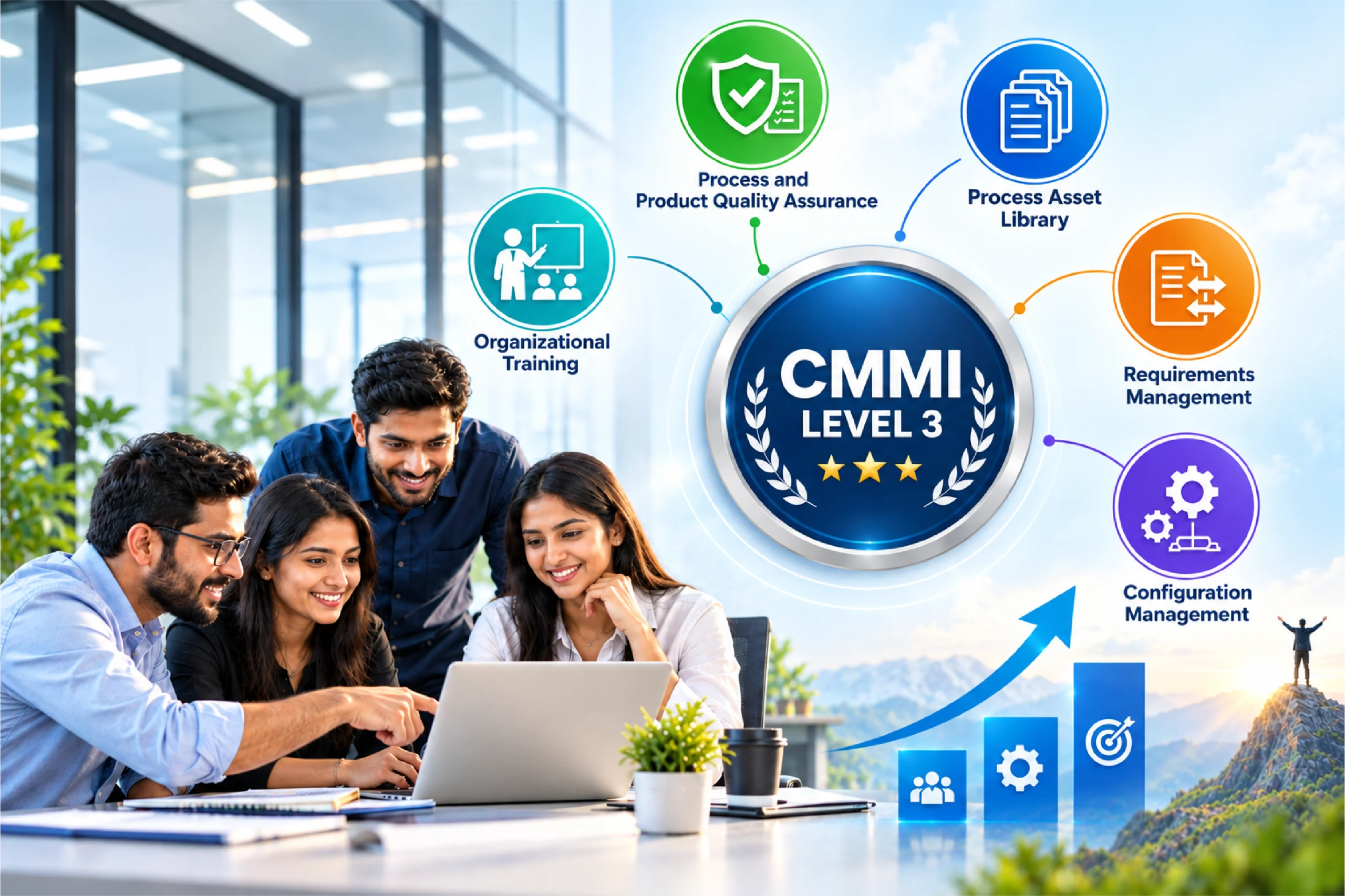
In a typical enterprise IT setup, teams think they are doing everything right if they build what the client asks for and pass QA testing. CMMI Level 3 requires a broader, interconnected view of the full lifecycle. During our preparation, we closed subtle operational gaps by formalizing several key practices:
1. Process and Product Quality Assurance (PPQA)
Quality is no longer limited to finding defects in code. Formal PPQA practices let us objectively evaluate whether teams are following the defined processes and producing work products that meet organizational standards—catching process issues before they become product defects.
2. Process Asset Library (PAL) / Organizational Process Assets
We established a centralized library of standard processes, lifecycle descriptions, tailoring guidelines, estimation templates, and historical metrics. New teams no longer start from a blank slate; they draw proven frameworks from the PAL, reducing ramp-up time and project risk.
3. Requirements Management and Traceability
Bidirectional requirements traceability maps every business need to design elements, code, and test cases. This gives clear visibility into the impact of any change and helps control scope effectively.
4. Configuration Management (CM) and Baselines
Beyond version control, we now establish formal configuration baselines at key milestones and conduct systematic audits. Clients always know the exact, verified state of their software assets.
5. Organizational Training (OT)
Knowledge sharing has become a structured, data-driven program. We identify competency gaps, align training with upcoming technology needs, and use organizational process assets to systematically upskill our teams.
What CMMI Level 3 Means For Our Clients
For the Fortune 500+ companies and multinational corporations that rely on our software delivery services, our CMMI Level 3 certification is far more than a technical validation. It is a direct risk-mitigation guarantee. In the enterprise world, unpredictability is the ultimate enemy. By layering advanced governance like PAL, PPQA, and RTM over our 14 years of engineering expertise, we provide our global clients with distinct operational advantages:
1. Predictable Project Delivery
Standardized and audited processes help improve planning accuracy, delivery consistency, and project visibility.
2. Enhanced Quality Assurance
Defined quality practices enable proactive identification and resolution of issues throughout the development lifecycle.
3. Improved Risk Management
Structured governance and monitoring reduce project uncertainties and support better business outcomes.
4. Greater Transparency
Clear processes and documentation help clients ensure alignment between business objectives, project execution, and final deliverables.
5. Continuous Improvement
A culture of ongoing evaluation and optimization allows us to consistently enhance service quality and customer experience.
Looking Ahead
Reaching CMMI Maturity Level 3 is not a finish line. It is a solid foundation for the next phase of growth and innovation. We have taken the flexible, passionate engineering culture that powered our first 15+ years and strengthened it with corporate-grade operational discipline.
As we continue to build, scale, and transform complex digital ecosystems for enterprise clients around the world, we do so with the confidence that our processes are as robust, sophisticated, and reliable as the solutions we deliver.
Frequently Asked Questions
What is the main difference between CMMI Level 2 and Level 3?
Level 2 focuses on managing individual projects—processes are planned, performed, measured, and controlled at the project level. Level 3 makes those processes organization-wide: standard processes are defined, projects tailor them according to guidelines, and the whole organization shares and improves the same process assets.
Which Process Areas are typically addressed at CMMI Level 3?
In addition to the Level 2 process areas, Level 3 includes Requirements Development, Technical Solution, Product Integration, Verification, Validation, Organizational Process Focus, Organizational Process Definition, Organizational Training, Integrated Project Management, Risk Management and Decision Analysis and Resolution (among others, depending on the exact model version and constellation used).
Can CMMI Level 3 work with Agile and Scrum?
Yes. Scrum provides effective “how” practices for planning, daily coordination, and iterative delivery, while CMMI supplies the organizational structure, process assets, training, and measurement framework that make Agile practices consistent and scalable across the company. This is why many organizations with CMMI Level 3 maturity successfully combine them.
How does CMMI Level 3 help reduce post-launch defects?
Through stronger requirements traceability, formal process quality assurance, configuration baselines, and early verification/validation practices, issues are detected and corrected earlier in the lifecycle—before they reach production.