You probably deal with this every week: customer data scattered across your CRM, ad platforms, email tools, analytics, and now AI agents. The same “engaged customer” or “qualified lead” gets defined differently in each system. Marketing sees one version, sales another, and finance a third. When you pull reports or feed this scattered data into AI for personalization or attribution, the results don’t line up.
This is where Open Semantic Interchange becomes a game-changer. Open Semantic Interchange (OSI) is an open, vendor-neutral standard (backed by Snowflake, Salesforce, dbt Labs, and others) that fixes exactly this. With OSI, different teams finally work from the same logic, and AI gets reliable context, so outputs are more accurate and actionable without constant manual fixes. For marketers, marketing success depends less on how much data you collect and more on how clearly that data communicates intent and relevance. Hence, this shift to OSI makes a significant difference.
This article breaks down what Open Semantic Interchange really is—and why OSI matters to marketers.
- What is Open Semantic Interchange (OSI)?
- How Open Semantic Interchange Powers Smarter CRM Marketing
- Open Semantic Interchange and AI Marketing Automation
- The Microsoft Ecosystem and OSI
- Benefits of Open Semantic Interchange
- Why Marketers Should Pay Attention Now
- To Conclude
- Frequently Asked Questions
What is Open Semantic Interchange (OSI)?
Open Semantic Interchange is about shared understanding between systems. Traditional integrations often move data fields such as names, emails, clicks, and purchases, without context. One tool may interpret “engagement score” differently from another. This leads to inconsistencies, misaligned campaigns, and poor personalisation.
Open Semantic Interchange introduces a shared semantic layer. That means systems don’t just exchange data; they exchange definitions. A “qualified lead,” “high-intent customer,” or “inactive subscriber” carries the same meaning everywhere.
For marketers, this consistency is essential. Without Open Semantic Interchange, CRM segmentation, ad targeting, and email journeys operate on conflicting logic—leading to broken customer experiences and wasted budget. OSI helps marketing teams design journeys once and trust that every system interprets them the same way.
How Open Semantic Interchange Powers Smarter CRM Marketing
CRM marketing depends on understanding customer relationships over time. But when data is inconsistent, even the best strategy fails.
By implementing Open Semantic Interchange, marketers ensure that:
- Customer lifecycle stages are consistent across tools
- Behavioural triggers mean the same thing in every platform
- Lead scoring logic aligns between sales and marketing
For example, if a customer downloads a pricing guide, one system might mark them as “high intent,” while another logs it as simple “content engagement.” With Open Semantic Interchange, both systems recognise it as a buying signal. This alignment strengthens CRM marketing automation by ensuring the right follow-up happens at the right time.
Open Semantic Interchange and AI Marketing Automation
AI marketing automation thrives on pattern recognition. It predicts what customers might do next and recommends actions such as sending offers, adjusting messaging, or prioritizing leads. However, inconsistent data definitions weaken these predictions.
Open Semantic Interchange improves AI automation by standardizing behavioral signals. When AI models trained on unified semantic data analyze customer journeys, they produce more accurate outcomes. This leads to:
- Better lead scoring
- More precise churn prediction
- Smarter content recommendations
For marketers, this means AI-driven marketing automation campaigns feel more relevant and less intrusive.
The Microsoft Ecosystem and OSI
Businesses using Microsoft Dynamics 365 already manage rich customer and operational data. When Open Semantic Interchange principles are applied, that data becomes more actionable across marketing, sales, and service teams.
Similarly, Microsoft Power Platform enables teams to build custom apps, dashboards, and AI automation workflows. With Open Semantic Interchange, these solutions rely on consistent definitions, making CRM marketing automation more scalable and reliable.
For example, a marketer can design a journey in Power Automate that is influenced based on customer intent signals stored in Dynamics 365. Because Open Semantic Interchange keeps definitions aligned, every department works from the same playbook.
Benefits of Open Semantic Interchange
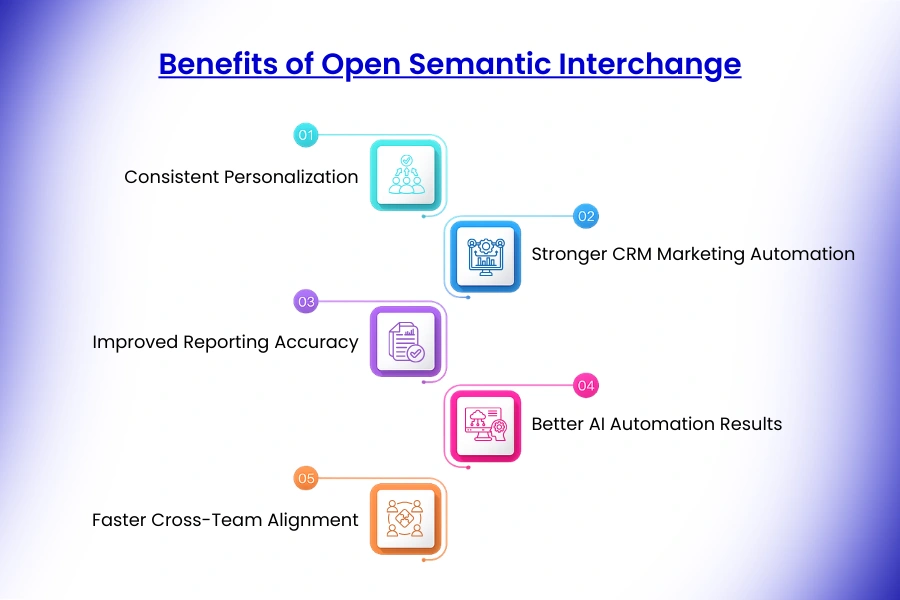
Organizations that embrace Open Semantic Interchange gain a measurable advantage. Let’s have a thorough review of how OSI benefits marketers to design a strategic approach and drive aspirational outcomes.
1. Consistent Personalization
Personalisation depends on understanding customer behaviour. Open Semantic Interchange ensures that AI marketing automation tools interpret those behaviours uniformly, leading to more relevant experiences.
2. Stronger CRM Marketing Automation
Automated journeys rely on triggers and segmentation rules. With Open Semantic Interchange, those triggers operate on shared definitions, making CRM marketing automation more dependable.
3. Improved Reporting Accuracy
When platforms categorise events differently, reports become misleading. Open Semantic Interchange standardises event meaning, improving attribution and performance measurement in CRM marketing.
4. Better AI Automation Results
AI automation performs best when data is structured and meaningful. Open Semantic Interchange gives AI systems the clarity they need to deliver actionable insights.
5. Faster Cross-Team Alignment
Sales, marketing, and service teams often interpret customer signals differently. Open Semantic Interchange bridges these gaps, creating a unified customer view that benefits CRM marketing strategies.
Why Marketers Should Pay Attention Now
Marketing is increasingly driven by AI marketing automation. AI tools analyse behaviour, predict intent, and personalise outreach. But AI systems depend on clean, well-defined data. If the same behaviour is labelled differently across platforms, AI automation models lose accuracy.
By using Open Semantic Interchange, marketing teams ensure AI engines work with consistent signals. That improves targeting, forecasting, and engagement strategies across CRM marketing initiatives. To be precise, Open Semantic Interchange makes AI more reliable and marketing more predictable.
To Conclude
Open Semantic Interchange is not just a technical concept; it is a strategic shift in how organisations treat marketing data. By ensuring shared meaning across systems, businesses strengthen CRM marketing, improve the reliability of AI marketing automation, and make smarter use of AI automation overall. As marketing technology continues to evolve, semantic consistency will play a central role in delivering connected, data-driven, personalized customer experiences.
Implementing Open Semantic Interchange requires both technical depth and marketing insight. Soluzione helps organisations bridge this gap by aligning data strategies with business goals.
With strong expertise in Microsoft Dynamics 365 services, Microsoft Power Platform, and CRM marketing, Soluzione helps organisations bring clarity to disconnected systems and leverage data to their use. Open Semantic Interchange is a strategic move toward more coordinated marketing operations and technical advancement. Soluzione collaborates with companies to implement these upgrades in ways that facilitate more efficient processes, wiser choices, and sustained effectiveness. Connect with our experts now to learn more!
Read More: https://www.solzit.com/blog/
Frequently Asked Questions
Why should digital marketers care about Open Semantic Interchange?
Digital marketers rely on multiple tools to track and engage customers. Without Open Semantic Interchange, those tools may interpret customer behaviour differently, causing inconsistent targeting and reporting. OSI helps marketers make more accurate decisions because all platforms work from the same definitions and customer signals.
How does OSI improve data interoperability across marketing platforms?
Open Semantic Interchange improves interoperability by creating shared definitions for customer actions, lifecycle stages, and engagement levels. This allows marketing platforms, analytics tools, and CRM systems to exchange data without losing context, reducing errors and mismatched insights.
What role does OSI play in AI-driven marketing and automation?
AI systems depend on well-structured data. Open Semantic Interchange ensures that behavioural signals and customer attributes are interpreted consistently, which improves the accuracy of predictions, recommendations, and automated marketing actions.
How can OSI enhance personalisation and customer experience?
When platforms share a common understanding of customer behaviour, personalisation becomes more accurate and meaningful. Open Semantic Interchange helps ensure that messages, offers, and timing are based on a unified customer profile, creating smoother and more consistent experiences across touchpoints.
Can OSI integrate with existing CRM and marketing automation tools?
Yes, Open Semantic Interchange is designed to work alongside existing CRM and marketing automation platforms. It acts as a semantic layer that aligns data definitions across systems, improving how tools communicate without requiring a complete technology overhaul.