From ordering groceries with a single tap to immersing in features like augmented reality shopping, mobile apps continue to reshape how we live, work, and connect. In 2025, this pace of trend has only accelerated, with businesses, developers, and users closely watching the next wave of mobile app trends that will shape the digital landscape.
No worries, we have got you covered with our first-hand research and analysis. In this blog, we’ll explore the 16 must-watch mobile app trends for 2025, backed by industry insights and evolving user behavior.
The Top 16 Mobile App Development Trends for 2025
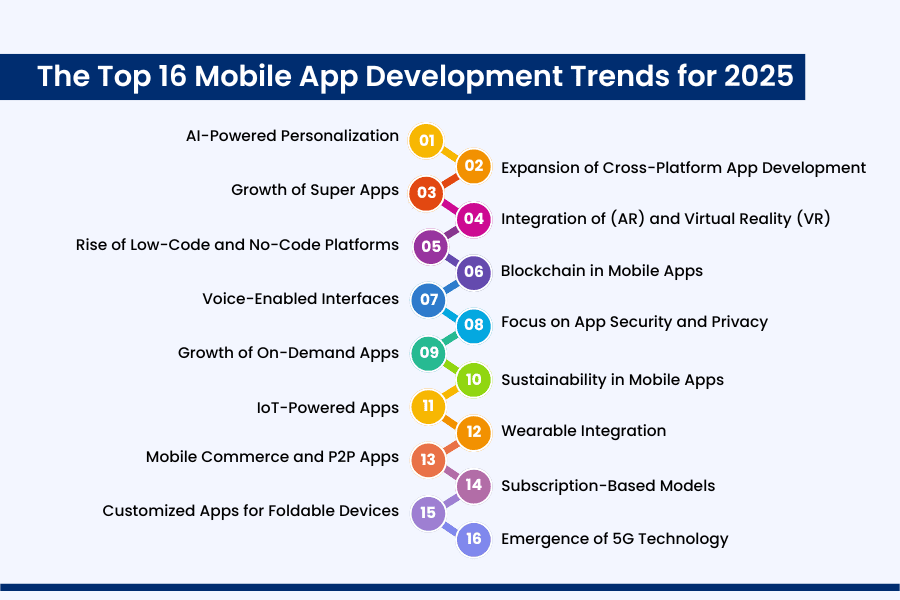
Immersive innovation with compelling features and integrated AI is the new normal in most app development trends, but what’s apart from this? How are new-gen apps being designed? To discuss the same, here are the top 15 comprehensively researched mobile app development trends that are booming in 2025, with a futuristic scope.
1. AI-Powered Personalization
Artificial Intelligence (AI) is a revolutionary technology that is designing how innovation works and navigates in the future. In 2025, AI will enable apps to deliver hyper-personalized experiences to users. From Netflix recommendations to fitness apps suggesting tailored routines, AI algorithms are constantly learning from user interactions.
AI also enhances customer support through advanced chatbots and voice assistants, giving new trending apps an edge in delivering seamless experiences. Businesses integrating AI into their app development technologies will witness stronger engagement and user loyalty over those who stick to conventional app development frameworks.
2. Expansion of Cross-Platform App Development
Cross-platform is gaining massive attention as businesses aim to reach a broader audience with a cost-effective approach. Frameworks like Flutter and React Native are allowing developers to create apps that function smoothly across iOS, Android, and even desktops.
In 2025, mobile app development trends will further emphasize a unified software development process, cost-saving, while speeding up deployment. Hence, with the growing and maturing mobile app development trends, cross-platform app development definitely empowers how businesses access a massive audience base.
3. Growth of Super Apps
As of 2025, businesses are already experimenting with super app modules, being inspired by the success of apps like WeChat and Grab. Integrated with multiple services, including payments, shopping, travel, and messaging, super apps function incredibly well as a unified multiservice platform.
These apps significantly rely on the latest app development technologies, including AI, cloud computing, blockchain technology for security, and others. In fact, the current mobile app trends indicate that users prefer fewer apps that serve multiple needs, reducing digital clutter. Moreover, super apps precisely meet this industry demand by being an effective unified platform that works multipurpose.
4. Integration of Augmented Reality (AR) and Virtual Reality (VR)
Gone are the days when Augmented Reality (AR) and Virtual Reality (VR) were only known for the gaming platforms. Today, retailers, real estate agencies, and educational platforms are increasingly using AR/VR to provide immersive experiences to their customers.
With constantly evolving technologies in the future, AR-enabled shopping apps or VR-based classroom experiences will create a new perspective on how customers interact with brands digitally.
5. Rise of Low-Code and No-Code Platforms
With the surge in app development demand, businesses aspiring to launch themselves digitally should not wait for months to have an app with a complex layout and intricate modules. Hence, the ultimate solution to tackle this challenge is low-code and no-code platforms that enable individuals or enterprises with low or no technical understanding to create functional apps with minimal coding.
In the future, this will also complement cross-platform app development, making it easier to scale apps across multiple devices, giving startups a competitive edge against established enterprises.
6. Blockchain in Mobile Apps
With the growing digital reliance, online scams have become a delicate challenge for innovation and technology. Hence, in 2025, developers are thoughtfully focusing on blockchain mobile app technology, giving the app development future a safer perimeter to sustain unseen deceptions.
From finance to healthcare, blockchain is becoming paramount to securing data and enhancing transparency. Hence, companies without an encrypted data setup are losing the race, whereas most businesses are already integrating blockchain technology, ensuring an improved yet robust enterprise and customer data protection. This factor also highly contributes to analyzing the credibility and sustainability of any business in the market.
7. Voice-Enabled Interfaces
People are gradually becoming habituated to interacting with voice-enabled interfaces. While voice search is still fully functional in AI chatbots or search engines, it will soon be integrated into the trending mobile applications. With the popularity of Siri, Alexa, and Google Assistant, users are getting comfortable with voice interactions.
In 2025, Voice search and commands will be a major focus of mobile app development technologies, and businesses that adapt to this technology will have a higher possibility to rank among the top trending mobile apps in the future.
8. Focus on App Security and Privacy
With rising cyber threats, user trust depends on how secure their data is. Apps in 2025 and beyond can no longer compromise on having features like multi-factor authentication, biometric logins, and end-to-end encryption.
While customer data resides in the digital space, safeguarding it will remain crucial to the future of the mobile app development industry.
9. Growth of On-Demand Apps:
The convenience economy is thriving, and consumers want on-demand products.
As per PWC, “The on-demand economy is projected to surge, reaching an impressive $335 billion by the year 2025.”
It will help businesses to meet the varied demands of their customers and provide them with hyper-personalized solutions or recommendations. Moreover, in 2025 and beyond, customer-centric apps will have an elevated scope to sustain in the fiercely competitive app development market.
10. Sustainability in Mobile Apps
Users are becoming conscious of how their digital choices impact the environment. In 2025, apps designed with sustainable practices, like energy-efficient coding and eco-friendly solutions, will gain popularity. This shift will further influence some new mobile app development trends, as developers adopt greener approaches like greencode development with the latest innovative integrations.
11. IoT-Powered Apps
In 2025, mobile app technology will integrate the Internet of Things (IoT) more seamlessly, enabling users to control multiple devices through a single app. This will bridge the gap between the digital and physical world, giving businesses a new edge to scale and compete in the modern digital landscape.
12. Wearable Integration
Digital wearables are no longer restricted to only the health industry. In 2025, apps will connect with AR glasses, smart rings, and even clothing sensors. While Samsung has already launched its digital ring in 2024, there are predictions that Apple is soon to launch one, along with other digital wearable accessories.
This expansion demonstrates how mobile app development is closely tied to hardware innovation as well. For developers, wearable-centric design is among the latest app development technologies shaping the digital future.
13. Mobile Commerce and P2P Apps:
The growth in digital buying and selling is fueling mobile commerce app development, making it a popular trend in 2025 and beyond. Multiple new brand launches are fostering mobile commerce and changing the way people book hotels, purchase products, or even sell them. Some trending apps infused with mobile commerce and already dominating the digital market are Amazon and Etsy.
Moreover, Peer-to-Peer (P2P) apps allow individuals to connect directly via an online network in order to share money, goods, or information. It does not require any traditional intermediaries, yet works seamlessly in the digital space, enabling humans to connect faster and share the requisites directly with each other.
14. Subscription-Based Models
Finally, monetization strategies are evolving. Users are more willing to pay for value, whether through streaming services, premium fitness apps, or productivity tools.
By 2025, subscription app models will dominate as the top trending mobile apps, replacing traditional one-time purchase prototypes. This monetization approach is supported by the latest app development technologies that enable secure payments and smooth recurring billing cycles.
15. Customized Apps for Foldable Devices
Customers’ constant change in choices is the pivot of how innovation works, and foldable devices are one of them that are shaping how mobile applications should be designed in the future. Apps for foldable devices are designed to adapt to the flexible screens and layouts, offering a dual-pane interface. They are backed by enhanced multi-window support and features tailored to the specific foldable devices.
This is because today, people seek uniqueness and enhanced multitasking capabilities, along with a rich user experience within a unified device. Hence, businesses are now ensuring that the modern applications remain compatible with foldable devices and more such upcoming innovations.
16. Emergence of 5G Technology
Quicker, smoother, and richer in experience! Mobile applications are being empowered by 5G technology, which allows developers to code more engaging and complex app experiences.
5G enables low latency and faster speed, allowing developers to remain creative, interactive, and data-intensive with their application development process and launch businesses with a redefined user experience that is paramount to the modern consumer demands.
What’s Ahead in the Mobile App Development Industry?
The list doesn’t just end here, as the future of the tech industry holds enormous opportunities for breeding trends that are yet to gain attention. While businesses are already integrating their existing technical setup with cloud computing in mobile apps, the industry is constantly experimenting with improvements and better versions of sustainable yet efficient application development.
Hence, instant apps, beacon technology integration in mobile apps, touchless user interfaces, and edge computing are some other rapidly scaling mobile app development technologies that we can expect to witness at the forefront in the future.
Final Words
In 2025, these 16 must-watch mobile app trends highlight just how fast the industry is evolving. Businesses and developers that embrace innovations in mobile app development, cross-platform app development, and the latest app development technologies will stay ahead of the curve.
From AI personalization to IoT, from AR/VR to sustainability, the future of mobile app development is brimming with opportunities. Whether you’re a developer looking to innovate or a business seeking growth, aligning with these mobile app development trends will ensure you don’t just keep up; you lead.
Hence, Soluzione is at your rescue, where our experts not only give you personalized assistance but also develop tailored mobile applications that meet your business’s objectives and customer requirements, integrated with the latest features and UI/UX. Embark on this revolutionary digital journey by partnering with the leading experts in the tech industry at Soluzione. We are just a call away—connect now!
Read More: https://www.solzit.com/blog/
Frequently Asked Questions
How is AI influencing the future of mobile applications?
AI is designing how the mobile app development industry is perceived in the future. Artificial intelligence integration in modern applications is known for its smarter recommendations to users, voice search assistance, predictive analytics for informed decision-making, advanced chatbots for customer support, and overall app modules emphasizing business growth.
Why is cross-platform development gaining popularity among app developers?
Cross-platform app development is fundamental for modern app designs. It allows developers to code applications that can run smoothly across diverse platforms like iOS, Android, or any other. Moreover, it works with a single codebase, which reduces cost and time yet ensures consistent performance, which makes it one of the most popular development approaches.
How are businesses leveraging mobile apps to improve customer engagement?
To keep users engaged, businesses use popular mobile apps that integrate AI, push notifications, loyalty plans, AR/VR experiences, and real-time personalization. Mobile apps improve customer retention and satisfaction by acting as direct touchpoints.
How can companies future-proof their mobile apps to stay competitive?
Companies can future-proof apps by adopting the latest app development technologies, ensuring strong security measures, prioritizing user experience, leveraging scalable app development technologies like cloud and edge computing, and regularly updating apps to align with evolving mobile app technology.