Most software service providers claim to take information security seriously, but with an independent certification, the recipient gets stronger evidence that appropriate security policies, processes, and controls are in place. This is especially important when a development partner has access to sensitive assets such as source code, customer information, or production systems.
ISO/IEC 27001:2022 is an internationally recognized standard designed to help organizations manage information security risks systematically. It requires organizations to establish and maintain an Information Security Management System (ISMS), which provides a structured approach to protecting data, managing risks, responding to incidents, and continually improving security practices.
In this article, you will understand everything about ISO/IEC 27001:2022 and how it protects recipients who work with an organization holding ISO/IEC 27001.
- What is the ISO 27001 Standard for Information Security Management?
- Key Principle of ISO 27001
- Two Main Parts of ISO 27001 Standard
- ISO 27001:2022 Updates
- Statement of Applicability (SoA)
- Certification Process of ISO 27001
- Why is ISO/IEC 27001 Important to Clients?
- How Soluzione Implements ISO 27001:2022
- How ISO 27001 Is Different Than CMMI Level 3
- Questions to Ask to Check if a Company is ISO 27001 Certified
- The Bottom Line
- Frequently Asked Questions
What is the ISO 27001 Standard for Information Security Management?
ISO/IEC 27001 is the world’s best-known standard for an Information Security Management System (ISMS): a structured, documented and continuously improved way of protecting information. The current edition was published in October 2022 and replaced the 2013 version. Organizations certified to the older edition had a transition window that closed on 31 October 2025, so any vendor still presenting a 2013 certificate today is presenting an expired one. An amendment issued in 2024 also asks organizations to consider whether climate change is relevant to their ISMS.
Key Principle of ISO 27001
Two aspects of the standard are often misunderstood:
- First, the standard is about management, not products. It does not tell a company to buy a particular firewall; it requires leadership to identify risks to information, decide how to treat them, and prove the decisions work.
- Second, it covers all information, not only IT systems: paper records, people, premises and suppliers are all in scope.
Two Main Parts of ISO 27001 Standard
- Clauses 4 to 10 (mandatory): context of the organization, leadership commitment, planning and risk assessment, support and resources, operation, performance evaluation (internal audits and management review), and improvement.
- Annex A (controls): a reference set of 93 controls, reduced from 114 in 2013 and regrouped into four themes: Organizational (37), People (8), Physical (14) and Technological (34).
ISO 27001:2022 Updates
The 2022 revision introduced 11 new controls that read like a map of modern software risk: threat intelligence, information security for the use of cloud services, ICT readiness for business continuity, physical security monitoring, configuration management, information deletion, data masking, data leakage prevention, monitoring activities, web filtering and secure coding.
Statement of Applicability (SoA)
Organizations must determine which Annex A controls apply to their environment and document their decisions in a Statement of Applicability (SoA), including justification for any excluded controls.
Certification Process of ISO 27001
Certification is granted by an accredited external body after a two-stage audit, then maintained through annual surveillance audits and a full recertification every three years. This ensures the ISMS remains effective and continuously improves over time.
Why is ISO/IEC 27001 Important to Clients?
An ISO/IEC 27001-certified development partner follows a structured, organization-wide approach to information security.
Unlike a typical vendor, a development partner operates within your trust boundary. Its teams often access your architecture, environments, systems, and data throughout the development lifecycle. As a result, weaknesses in their security practices can directly impact your business.
With data breaches becoming increasingly costly and regulatory expectations growing stricter, organizations must ensure that third-party providers are not only trusted but also governed by proven security practices.
A certified Information Security Management System (ISMS) provides that assurance through documented processes, risk management, accountability, and continuous improvement.
In practice, this means:
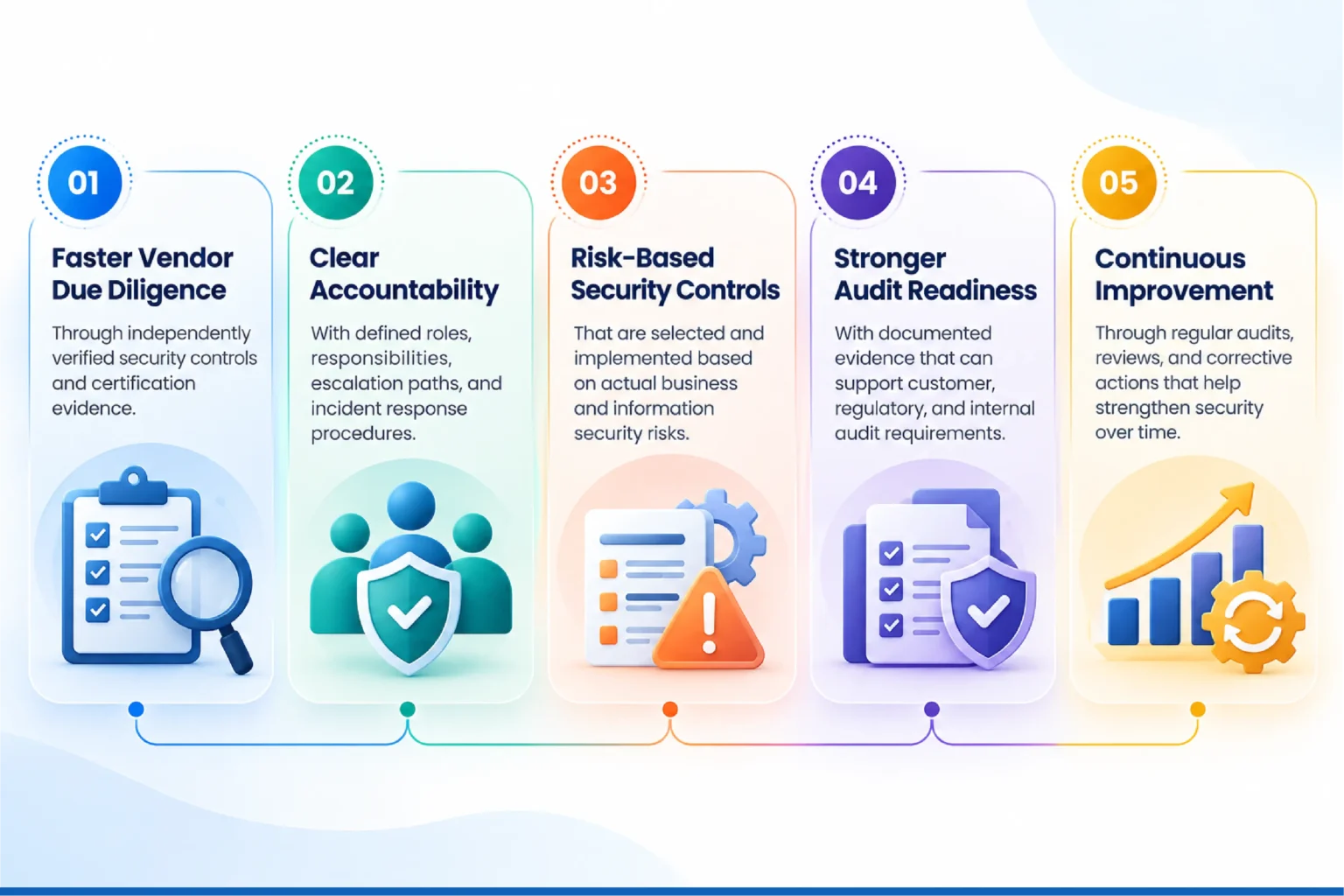
- Faster vendor due diligence through independently verified security controls and certification evidence.
- Clear accountability with defined roles, responsibilities, escalation paths, and incident response procedures.
- Risk-based security controls that are selected and implemented based on actual business and information security risks.
- Stronger audit readiness with documented evidence that can support customer, regulatory, and internal audit requirements.
- Continuous improvement through regular audits, reviews, and corrective actions that help strengthen security over time.
How Soluzione Implements ISO 27001:2022
Achieving ISO 27001 certification is not the goal in itself. The real value comes from embedding information security into everyday operations, development processes, and client engagement practices.
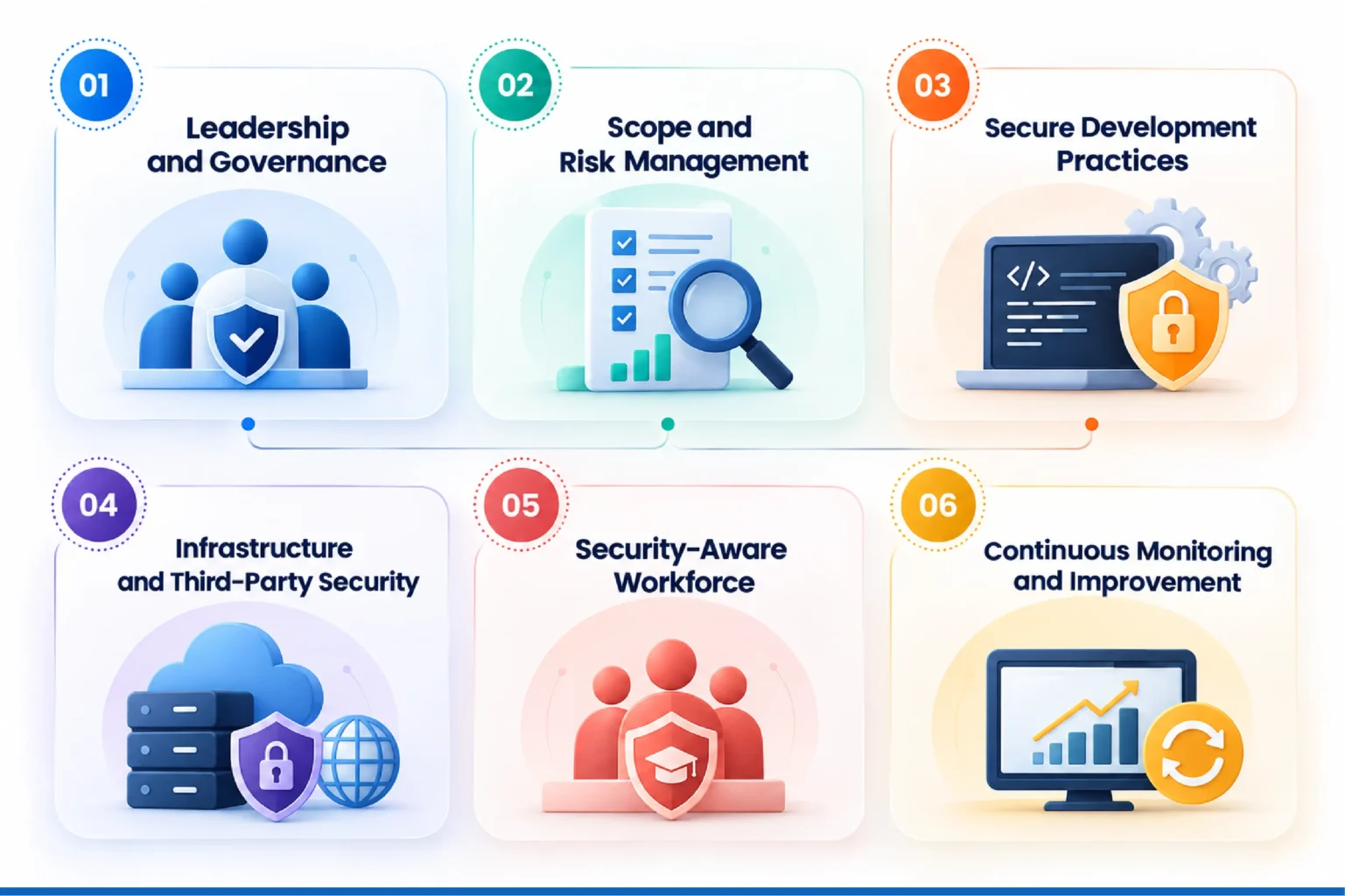
1. Leadership and Governance
Information security is driven from the top. Management establishes security objectives, defines policies, assigns ISMS ownership, and ensures the resources needed to maintain effective security practices.
2. Scope and Risk Management
We clearly define the teams, systems, locations, and client engagements covered by our ISMS. Information assets are identified, risks are assessed, and appropriate mitigation measures are implemented through a documented risk management process.
3. Secure Development Practices
Security is integrated throughout the software development lifecycle through:
- Secure coding standards and peer reviews
- CI/CD security checks and dependency scanning
- Role-based access controls and multi-factor authentication
- Segregated development, testing, and production environments
- Data masking and secure data handling practices
- Configuration management and continuous monitoring
4. Infrastructure and Third-Party Security
We maintain secure endpoints, encrypted storage, secure remote access practices, and conduct security assessments for suppliers and cloud service providers before onboarding.
5. Security-Aware Workforce
Employees undergo security awareness training, confidentiality agreements, onboarding security programs, and regular refresher sessions to promote a strong security culture across the organization.
6. Continuous Monitoring and Improvement
Regular internal audits, management reviews, performance monitoring, and corrective actions help ensure that our ISMS remains effective, compliant, and continuously improving over time.
How ISO 27001 Is Different Than CMMI Level 3
Clients frequently ask which one matters more. The better question is what each one proves, because they answer different questions.
| Dimension | ISO/IEC 27001:2022 | CMMI Level 3 (Defined) |
| Core question | Is information protected, and can the organization prove it? | Are engineering and service processes standardized and repeatable? |
| Focus | Risk-based information security management | Process maturity and performance across delivery |
| Nature | Certifiable requirements standard | Capability and maturity model, appraised rather than certified |
| Assessed by | Accredited certification body | CMMI Institute-authorized lead appraiser (SCAMPI appraisal) |
| Cycle | Annual surveillance, three-year recertification | Appraisal valid for three years |
| Typical evidence | Risk register, Statement of Applicability, audit records | Defined organization-wide processes, project tailoring, measurement data |
| Client benefit | Lower exposure to data loss, leakage and compliance failure | Predictable quality, schedule and cost, fewer surprises |
In short, ISO 27001 tells you whether your data is safe in a partner’s hands. CMMI Level 3 tells you whether the partner delivers in a disciplined, repeatable way. A vendor can have one without the other: a company can run beautifully standardized projects while leaving laptops unencrypted, or lock down its network while improvising its estimation and testing.
They are complementary, and they overlap usefully. Both demand documented processes, management involvement, measurement, and continual improvement. A team that already operates at Level 3 discipline finds it easier to implement an ISMS, and an ISMS provides CMMI-style processes with a security backbone. For regulated and data-sensitive work such as fintech, healthcare and public sector, ISO 27001 is usually the non-negotiable entry ticket. For large, long-running programs where delivery predictability drives value, CMMI adds confidence. Ask for both, and read the scope of each.
Questions to Ask to Check if a Company is ISO 27001 Certified
A certificate is a starting point for diligence. Before you sign, ask:
- Is the certificate to the 2022 edition, and which accredited body issued it?
- Does the scope cover the teams, sites and systems that will handle your work?
- May we see the Statement of Applicability and a summary of the latest audit findings?
- How are incidents reported to clients, and within what timeframe?
- How do you handle our data in non-production environments, and what happens to it when the contract ends?
- How do you vet and monitor your own sub-suppliers and cloud providers?
- A vendor with a living ISMS answers these quickly and specifically. A vendor with a certificate on the wall tends to deflect.
The Bottom Line
Security that cannot be audited cannot be relied upon. ISO/IEC 27001:2022 provides clients with an independent, repeatable way to verify that a partner treats information as an asset to be governed, not as an assumption to be made. At Soluzione, we treat the standard as an operating discipline, because the trust you place in us is only worth what we can demonstrate.
If you are evaluating a software partner, or want to see how our ISMS applies to your project, we welcome the scrutiny. Contact the Soluzione team to request our certificate scope and a walkthrough of how security is built into our delivery process.
Frequently Asked Questions
Is ISO 27001 certification mandatory?
No. ISO 27001 is a voluntary international standard, and no general law forces a software company to hold it. In practice, though, it often becomes a requirement through other routes: client contracts, tender and vendor-onboarding criteria, and the expectations of regulated sectors such as banking, insurance, healthcare and government work. Many enterprise buyers will not shortlist a development partner without it, so for vendors serving these clients it is mandatory in everything but name. Some regulations also require demonstrable security controls without specifying a standard, and ISO 27001 is the most widely accepted way to demonstrate them.
What are the main benefits of ISO 27001 certification?
- Trust you can verify: Independent assurance replaces self-declared security.
- Lower risk of breaches and costly incidents, because controls are chosen against real, assessed risks.
- Faster sales and due diligence: Security questionnaires and audits become shorter when a certificate and its scope can be shown.
- Regulatory readiness: A documented ISMS supports obligations under data-protection and sector rules.
- Clear responsibilities: Everyone knows who owns which asset, risk, and incident response step.
- Steady improvement: Audits and reviews keep the system current as threats change.
How does ISO 27001 help your project?
It shapes how your work is handled from the first day. Access to your code and environments is limited to people who need it and reviewed regularly. Development, testing, and production stay separated, and real data is masked or replaced with test data wherever possible. Code goes through secure-coding standards, peer review, and vulnerability checks. Changes are logged and approved, backups are tested, and if something goes wrong, there is a defined incident process with clear communication to you. Staff are screened, bound by confidentiality and trained, and third-party tools and cloud providers are assessed before they touch your project. The practical result is fewer surprises and a clear audit trail you can show your own stakeholders.
Does ISO 27001 measure customer satisfaction?
Not directly. Customer satisfaction measurement belongs to quality standards such as ISO 9001. What ISO 27001 requires is that an organization assess the effectiveness of its security system, and many companies fold client-facing indicators into that assessment. Typical measures include the number and severity of security incidents, the time to detect and resolve them, how quickly clients are informed, the results of access reviews and phishing tests, the completion of staff training, and the number of open audit findings. Client feedback on security, collected through reviews and questionnaires, can sit alongside these.
How often is an ISO 27001 certified company audited?
Certification runs on a three-year cycle. A first certification audit takes place in two stages, a documentation review followed by an on-site assessment of how controls operate in practice. The certification body then returns for surveillance audits in each of the next two years, normally annually. In the third year, a full recertification audit renews the certificate for another cycle. In addition, the company must run its own internal audits at planned intervals, usually at least once a year, and hold regular management reviews. Serious changes, such as a significant incident or a change in scope, can also trigger extra scrutiny.