Artificial intelligence has moved far beyond simple automation and content generation. Today, a new category — agentic AI — is emerging as one of the most powerful tools for business transformation.
Unlike traditional automation that follows rigid rules or generative AI that responds to prompts, agentic AI can reason, plan, make decisions, and execute complex tasks autonomously to achieve specific business goals. It often requires minimal human intervention.
Businesses today are expected to move faster, serve customers better, and make smarter decisions. Agentic AI solves this by bringing intelligence and adaptability into the equation.
In this blog, we’ll help understand agentic AI, how it works, and where businesses can use it strategically to scale operations while staying competitive.
- What Is Agentic AI?
- How Agentic AI Works?
- Benefits of Agentic AI for Business Growth
- Real-World Applications Of Agentic AI
- Industries Rapidly Adopting Agentic AI
- Agentic AI Implementation Roadmap: How To Get Started?
- Measuring Success: KPIs for an Agentic Business
- Common Challenges In Agentic AI Adoption
- Why Businesses Are Adopting Agentic AI Now?
- Final Thoughts
- Frequently Asked Questions
What Is Agentic AI?
Agentic AI refers to an intelligent system designed to autonomously pursue goals. These systems don’t just follow instructions — they understand objectives, analyze situations, create plans, adapt to changes, and take action across multiple tools and systems with minimal human intervention.
Traditional Automation vs Generative AI vs Agentic AI
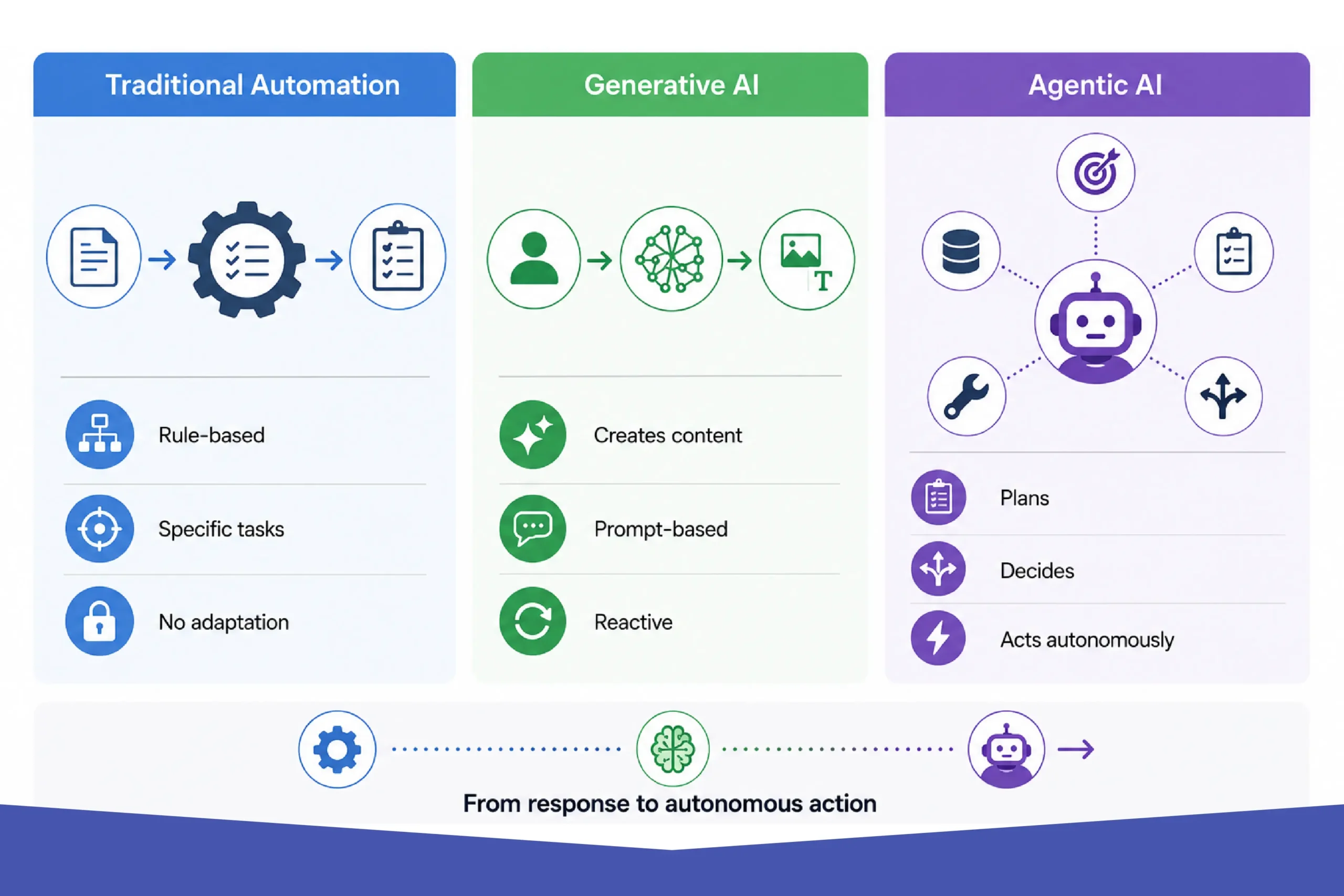
To truly understand agentic AI, it’s helpful to see how it evolved from earlier forms of AI.
Traditional Automation (Narrow or Rule-Based AI)
- Traditional automation is designed for specific tasks.
- It follows set rules and performs specific functions like fraud detection, recommendation engines, or predictive analytics.
- While useful, it has limited flexibility. No decision-making.
- It cannot adapt outside programmed boundaries.
Generative AI
Generative AI marked a major breakthrough. Powered by large language models, it can create original content such as text, images, code, and insights in response to user prompts. While powerful and creative, generative AI remains reactive — it depends heavily on human instructions and does not take independent action or pursue goals on its own.
Agentic AI
Agentic AI represents the next evolution. It builds upon Generative AI by adding reasoning, planning, memory, and autonomous execution. Instead of simply responding to prompts, agentic AI systems can:
- Understand complex goals
- Break them down into actionable steps
- Make real-time decisions
- Adapt strategies when conditions change
- Execute tasks across tools, systems, and workflows — often with minimal human oversight
This shift from “responding” to “acting autonomously toward objectives” is what makes agentic AI especially valuable for businesses.
How Agentic AI Works?
Behind the scenes, agentic AI operates through a combination of capabilities that allow it to function autonomously.
1.Perception
The system gathers data from various sources, customer interactions, internal tools, and market signals, and builds an understanding of what’s happening.
2. Reasoning
It processes information to make decisions. Instead of following fixed rules, it evaluates possibilities and chooses the effective path.
3. Memory and Context
Agentic AI systems can remember past actions and outcomes. This allows them to improve and make better decisions based on historical context.
4. Action Through Integration
Through seamless agentic AI integration, these systems can execute tasks across multiple platforms, CRM systems, marketing tools, support platforms, and more.
These may include updating CRM records, triggering workflows, responding to customer requests, scheduling follow-ups, and escalating issues when needed.
5. Multi-Agent Collaboration
In advanced enterprise environments, multiple AI agents can work together to complete complex workflows. One agent may gather information, another may analyze risks, while a third executes actions across connected systems. This collaborative approach allows businesses to automate end-to-end operations rather than isolated tasks.
Benefits of Agentic AI for Business Growth
Adopting agentic AI isn’t just about keeping up with trends; it delivers tangible business value.
1.Improved Operational Efficiency
By automating complex workflows, businesses can reduce manual effort and minimize errors. Tasks that once took hours can now be completed in minutes.
2. Smarter Decision-Making
With access to real-time data and predictive insights, agentic AI helps businesses make informed decisions.
3. Enhanced Customer Experience
Customers today expect quick personalized interactions. Agentic AI can analyze customer behavior and deliver tailored responses.
4. Scalability Without Complexity
As businesses grow, operations become difficult to manage with limited resources. Agentic AI solutions allow for scaling processes without increasing costs or resources.
5. Competitive Advantage
Organizations that adopt these systems early can respond faster to market changes and stay ahead of competitors.
6. Enterprise-Wide Transformation
Agentic AI does more than automate tasks; it transforms businesses’ operations. By connecting departments, systems, and workflows, organizations can become more agile, data-driven operations that respond faster to market changes and customer needs.
Real-World Applications Of Agentic AI
Agentic AI is not limited to a single function; it can be applied across businesses.
1.Customer Support
AI agents development service can resolve support requests, escalate complex issues, and personalize interactions.
2. Sales and Marketing
Agentic systems can analyze customer behavior, trigger personalized campaigns, qualify leads, and optimize outreach.
3. Human Resources
They can streamline candidate screening, schedule interviews, and assist with onboarding workflows.
4. Finance Operations
From invoice processing to anomaly detection and compliance checks, agentic systems improve speed and accuracy. Many processes are being automated, such as Know Your Customer (KYC) and client onboarding.
5. Supply Chain Management
They can monitor inventory, predict disruptions, and initiate corrective actions proactively.
These use cases show why organizations are increasingly exploring agentic AI solutions across departments.
Industries Rapidly Adopting Agentic AI
Agentic AI helps automate decisions, improve efficiency, and adapt to changing demands. Use of autonomous AI agents in streamlining workflows, offering personalized experiences, and improving overall business productivity.
| Industry | How Agentic AI Is Used |
| Healthcare | Patient scheduling, claims processing. |
| Retail | Delivers personalized recommendations and manages inventory forecasting |
| Banking & Finance | Automates fraud detection, KYC verification, and compliance monitoring |
| Manufacturing | Enables predictive maintenance and production workflow optimization |
| Manufacturing | Improves route planning, shipment tracking, and disruption management |
Agentic AI Implementation Roadmap: How To Get Started?
While the potential of agentic AI is significant, its successful adoption requires a structured and thoughtful approach. Here’s a practical step-by-step guide to help businesses implement it effectively.
Phase 1: Discovery & Quick Wins (Weeks 1–4)
- Audit current processes to identify high-impact opportunities (repetitive decisions, bottlenecks, high error rates, or heavy manual work).
- Prioritize 2–3 use cases with clear ROI potential, such as customer support triage or lead qualification.
- Assess data quality, system integrations, and readiness.
- Define success metrics upfront.
Phase 2: Pilot Projects (Weeks 5–12)
- Build or deploy 1–2 focused AI agents using off-the-shelf platforms or custom development.
- Run controlled pilots in a single department.
- Measure performance rigorously and gather feedback from users.
- Refine prompts, workflows, and guardrails based on real results.
Phase 3: Scale & Orchestration (Months 4–6)
- Expand successful agents across teams.
- Introduce multi-agent collaboration for end-to-end workflows.
- Integrate deeply with existing systems (CRM, ERP, marketing automation, etc.).
- Establish governance policies for security, compliance, and human oversight.
Phase 4: Enterprise Transformation (Month 6 Onward)
- Build a full Agentic Operating Model where AI agents become part of daily operations.
- Foster a culture of human-AI collaboration.
- Continuously optimize agents using feedback loops and performance data.
- Explore advanced capabilities like cross-department orchestration.
Implementation Approaches
- Buy: Use established platforms (e.g., Microsoft Copilot Studio or specialized agent frameworks).
- Build: Develop custom agents for highly unique needs.
- Partner: Work with experienced vendors who understand both technology and your industry.
Pro Tip: Focus on processes that are structured enough for automation yet benefit from intelligent decision-making.
Measuring Success: KPIs for an Agentic Business
Implementing Agentic AI is only valuable if you can prove — and continuously improve — its impact. Leading organizations and analysts (Google Cloud, McKinsey, Gartner, and others) recommend organizing KPIs into clear categories. The following metrics ensure you move beyond vanity metrics (like number of agents deployed) to real business value.
1. Agent Performance & Reliability KPIs
- Task Success Rate: Percentage of agent-initiated tasks completed end-to-end correctly without human intervention (target: 85–95%+ for mature systems).
- Autonomous Resolution Rate: Percent of issues or workflows fully handled by agents (common benchmark: 50–80% in customer service within the first year).
- Escalation Rate: How often agents hand off to humans (lower is better; aim to reduce over time).
- Tool/Action Selection Accuracy: How correctly the agent chooses the right tools, APIs, or next steps.
- Recovery Rate: Percent of failures the agent recovers from using retries, fallbacks, or clarification.
- Plan Optimality Score: How close the agent’s chosen path is to the most efficient possible solution.
2. Efficiency & Productivity KPIs
- Time Reduction / Task Duration: Average time saved per process (many organizations report 40–70% reduction, with some customer service resolutions dropping by up to 90%).
- Cost per Task / Cost per Resolution: Total cost (including AI infrastructure) to complete a task versus the previous manual or rule-based method.
- Automation Rate: Percentage of workflow steps or tickets handled autonomously.
- Productivity per Employee: Increase in output or capacity without adding headcount.
- Mean Time to Resolution (MTTR): Especially powerful in IT, operations, and customer support (typical improvements: 30–50%).
3. Business Outcome & ROI KPIs
- Return on Investment (ROI): Standard formula: (Net Benefits – Investment Cost) / Investment Cost × 100. Enterprise AI agents often deliver 3x–6x ROI within the first year, with top performers reaching 200–400% within 18–24 months.
- Cost Savings: Overall operational cost reduction (organizations commonly achieve 15–35% in targeted areas).
- Revenue Impact: Faster lead qualification, higher conversion rates, accelerated sales cycles, or new revenue streams enabled by agents.
- Customer Experience Metrics: CSAT, NPS, Repeat Contact Rate, and Customer Effort Score (many see 15–20+ point improvements).
- Error Reduction & Risk Mitigation: Decrease in compliance violations, rework, or financial errors.
4. Adoption & Organizational Health KPIs
- Adoption Rate: Percentage of employees or teams actively using agentic systems.
- User Satisfaction & Trust Score: Feedback on how well agents augment (not replace) human work.
- Agentic Maturity Level: Track progress using a 4-level model:
| Maturity Level | Description | Key Characteristics |
| Level 1 | Basic Automation | Rule-based tasks, single agents |
| Level 2 | Intelligent Agents | Reasoning + simple goal pursuit |
| Level 3 | Multi-Agent Collaboration | End-to-end workflows, orchestration |
| Level 4 | Fully Agentic Enterprise | Adaptive, organization-wide autonomous operations with continuous learning |
Common Challenges In Agentic AI Adoption
Businesses are increasingly adopting agentic AI to automate operations and improve decision-making. However, several challenges can affect successful implementation and long-term performance.
1.System Reliability Issues
AI agents may produce inconsistent results if prompts and workflows are not designed properly. So, use robust testing, clear guardrails, human-in-the-loop approvals for high-stakes decisions, and iterative prompt engineering.
2. Data Integration Problems
Business data is often stored across multiple tools, platforms, and departments. Poor integration or incomplete data can reduce AI performance, affecting decision-making accuracy. Integrating legacy systems with modern AI solutions can be time-consuming and expensive.
3. Security & Privacy Risks
Agentic AI systems may access sensitive customer or company information. Businesses must implement strong governance, encryption, and access management policies.
4. Governance and Accountability
Organizations need to provide clear rules for AI agents to make decisions. Human oversight should be implemented to prevent biased outcomes. Companies must define accountability when AI-driven actions affect operations or customers.
5. Lack of Skilled Talent
Many businesses struggle to find professionals with AI implementation expertise. High standards should be adopted during Employee training and upskilling for effective, seamless adoption.
6. Unclear ROI and Business Strategy
Some companies adopt AI without identifying specific business goals. Measuring the financial impact of AI initiatives can be challenging initially. A clear roadmap helps businesses align AI investments with operational requirements.
7. Need for Speedy Implementation
Pilot programs help organizations evaluate performance before scaling. Learnings allow teams to refine workflows and build confidence in AI systems.
Why Businesses Are Adopting Agentic AI Now?
Businesses today are under constant pressure to respond quickly, optimize costs, and deliver better customer experience. Traditional automation tools can handle repetitive tasks, but often struggle when situations require decision-making. That’s where Agentic AI is creating real impact.
Agentic AI can understand goals, adapt in real time, and take action with minimal human involvement. This allows businesses to respond better and improve efficiency across departments. Companies are dealing with large amounts of data, higher customer expectations, and competition, making automation more important than ever.
With advancements in AI models, cloud platforms, and integrations, businesses do not need massive infrastructure to implement AI-driven systems. Organizations are exploring agentic AI to build smarter, more agile operations that can scale and stay competitive in a fast-changing market.
Final Thoughts
Agentic AI is evolving innovation into a transformative force offering smart solutions in enterprise technology. As businesses face pressure to improve efficiency, optimize operational costs, and deliver personalized experiences, intelligent AI systems offer a scalable and adaptive solution.
Unlike traditional automation, agentic AI is capable of reasoning, making contextual decisions, and acting autonomously across workflows. Organizations can respond effectively to changing business demands.
Companies adopting agentic AI will be better positioned to drive innovation, scale operations, and stay competitive in a digital landscape.
The key to successful adoption lies in strategically focusing on measurable business outcomes and maintaining AI-driven execution balanced with human interface.
On this journey, Soluzione can help you transform your business with agentic AI capabilities that power your growth. Get in touch with us to learn more.
Read More: https://www.solzit.com/blog/
Frequently Asked Questions
How is agentic AI different from traditional automation and AI tools?
Traditional automation follows fixed rules, while agentic AI adapts dynamically. Unlike standard AI tools that require prompts, it independently plans actions, learns from context, and executes tasks intelligently.
Why is agentic AI becoming important for modern businesses?
Modern businesses need speed, adaptability, and efficiency. Agentic AI helps meet rising customer expectations, reduce operational costs, automate decisions, and support scalable digital transformation in increasingly competitive markets.
How can agentic AI improve customer experience and engagement?
Agentic AI personalizes interactions, responds instantly, anticipates customer needs, and resolves issues proactively. This creates faster, smarter, and more relevant experiences that improve satisfaction, trust, and long-term customer loyalty.
What tools or platforms are needed to build agentic AI solutions?
Building agentic AI solutions requires machine learning frameworks, large language models, workflow orchestration platforms, cloud infrastructure, API integration tools, and data management systems for seamless automation and intelligent decision-making.
How does agentic AI use data to make intelligent decisions?
Agentic AI gathers data from multiple sources, analyzes patterns, understands context, and applies reasoning models to choose actions. It continuously learns from outcomes, improving future decisions and operational accuracy.